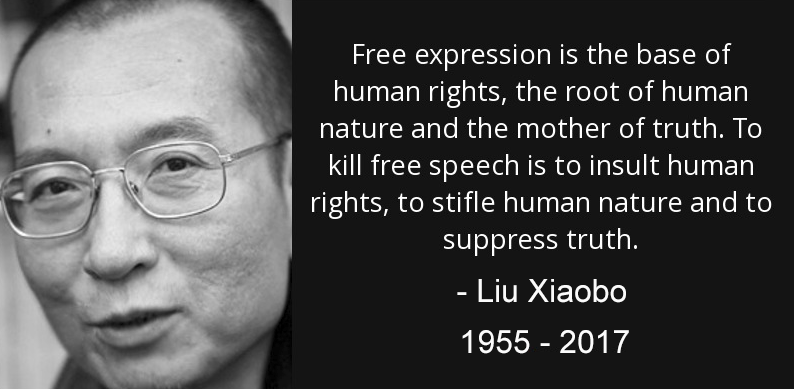


In China, the internet is so heavily regulated that anything is fair game to be censored. Whether you’re looking for “controversial” content, or just to find information about past events, chances are you won’t be able to find it. That’s because the Chinese government uses the internet as a tool to hide information just as much to spread it. Now, the Chinese government wants to hide a man this time to cover up its own dirty history. The man, is Liu Xiaobo.
Liu Xiaobo is one of China’s most honored political speakers and pacifist activists. In the past, Xiaobo helped student protesters in the infamous Tiananmen Square protests of 1989–in which hundreds students were wrongly murdered or injured by riot police (this event is still covered up to this day, even if photos recently leaked out about the incident).
In his past statements, Xiaobo demonstrated a remarkable aptitude for philanthropy. “I have no enemies and no hatred. None of the police who monitored, arrested and interrogated me, none of the prosecutors who indicted me, and none of the judges who judged me are my enemies,” Mr. Liu wrote this as he a prepared a statement in 2009. Since this date, Xiaobo has become a symbol for pro-democracy activists in China.
Now in 2017, Xiaobo has died while in state custody, and the Chinese government is trying to censor the discussion of his death. Candle emoticons and the phrase “R.I.P” were banned on Weibo–one of China’s biggest microblogging sites. In search engines, and many other sites, just the mere mention of Xiaobo was blocked–meaning that searches of his name turned up empty results.
Despite the censorship, users started to find creative ways to speak their voice. Code words, videos, and photographs started popping up to show solidarity towards Xiaobo–who just happens to be China’s only Nobel Peace Prize laureate.
Shortly after Xiaobo’s death there was a thunderstorm which lead Chinese citizens to believe it was a sign. One Weibo user wrote that the thunderstorm “must be to mark the exit of a hero” and that the “heavens have moved”. Another Wechat user thinks that “Heaven is watching” due to the harsh treatment of Xiaobo, who died in state custody due to untreated cancer.
Other images began to spring up on the internet symbolizing Xiaobo and his noble pursuits. One image portrayed an empty chair, symbolizing how Xiaobo couldn’t even pick up his Nobel peace prize earlier in 2009, due to his status as a political prisoner.
While Xiaobo is known overseas and to those in China aware of the past, his history and pursuits have been blocked on the internet for awhile–which means a lot of younger Chinese citizens are almost unaware of the man and his important political activism. Most mainland Chinese media services haven’t even reported the news, most likely in an effort to stay unmolested by the Chinese government.
Here at TorGuard, we value the power of free speech and we are moved by Xiaobo’s pursuits, even if they are largely hidden from the Chinese public eye due to censorship.
By utilizing censorship and surveillance, China can largely “delete history at will” which is a frightening thought. By using VPNs in China we can protect heroes like Xiaobo from becoming ghosts in the past.