

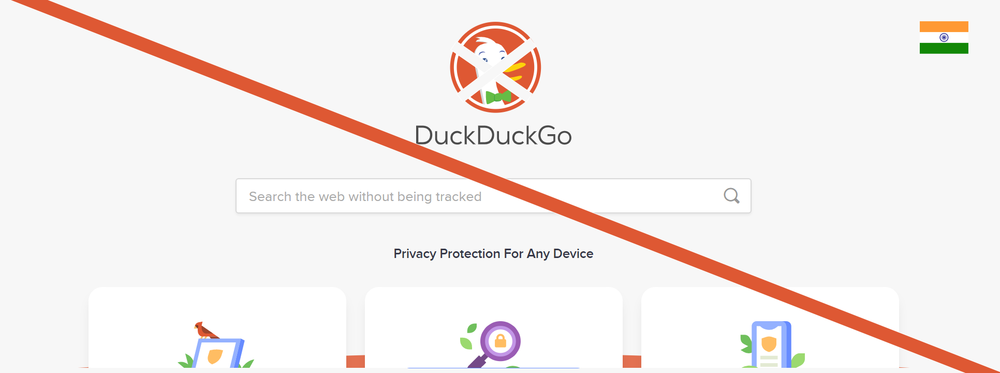
Many internet users in India were surprised to find that they were unable to access privacy oriented search engine DuckDuckGo this month. After DuckDuckGo confirmed that accessibility issues weren’t coming from their side, a deep dive confirmed that the inability to access the website stemmed from India’s Department of Telecommunications, the branch of government responsible for internet censorship.
What is DuckDuckGo?
DuckDuckGo is a major competitor to Google’s search engine. Despite Google’s motto, “Don’t Be Evil”, they have been accused of doing a fair number of evil things. Because Google relies on data to sell ads and target demographics, every single click its users makes is tracked and sold.
DuckDuckGo poses itself as the antithesis of Google. They promise a private search with tracker blocking and site encryption to prevent prying eyes (and advertisers) from crawling into your search results and targeting you. DuckDuckGo is designed to make your searches invisible to everyone, because quite frankly, they’re none of anyone’s business.
How the Block Was Discovered
Users in India attempting to access DuckDuckGo were met with problems. Some users reported errors stating that the website was unreachable, while others reported that they were met with a message stating that they were not authorized to access DuckDuckGo as per DoT compliance. This is how the population was able to distinguish whether an error or a block was in play.
Gurshabad Grover, a censorship researcher in India ran a series of tests that confirmed that DuckDuckGo was blocked by a number of popular internet providers in India under the direction of the government.
DuckDuckGo released the following statement: “To our users in India: We’ve received many reports our search engine is unreachable by much of India right now and have confirmed it is not due to us. We’re actively talking to Internet providers to get to the bottom of it ASAP. Thank you for your patience.”
After public outrage, DuckDuckGo became available to Indian internet users again. The government has yet to release a statement as to why it was blocked or unblocked. They have not acknowledged their efforts to suppress the website.
Internet Censorship in India
India does attempt to censor much of the internet, but they do so poorly. Most of the time, censorship attempts are made via DNS filtering. If users change their DNS settings to Google’s open DNS (a very simple process that a layman could complete in less than one minute), they’re able to bypass many of the blocks put in place by the Department of Telecommunications.
India does maintain some hard blocks. Blocks began one objectionable website at a time until blanket blocks were instituted. Internet pornography is banned in the country, and almost every region of India has an internet kill switch. In times of unrest and throughout serious political situations, many regions have used their kill switches to stop all communication.
Accessing the Open Internet in India
Switching DNS servers is sometimes all it takes to access blocked websites in India. Some websites are blocked a little better than others. When that happens, the only way to bypass those blocks is by using a VPN. The same applies for streaming content that’s blocked in the country, like videos on Netflix or YouTube.
TorGuard VPN works to bypass internet blocks in every region of India. Our stealth mode allows users to utilize our VPN services without ever even showing VPN use. Should the government decide to ban or regulate VPN use, stealth protocol users will be protected.