

LinkedIn is not a bastion of privacy by any stretch of the imagination. It’s a popular website for business networking, which means that it’s easy to find online users and reveal their real-life location, work history, and other personal information to others on the web.
A lot of it is due to the website’s nature, in that it acts like a public job history board for potential employers–but the site also doesn’t have exactly a “good” history with privacy since it has leaked passwords of 170 million users in the past. Now reports are coming in that LinkedIn is complying with Chinese censorship and doing a poor job of denying it.
The first person in question is corporate fraud investigator, Peter Humphrey–a British citizen who lives in the UK. He was informed by LinkedIn in December that his profile had been censored in China. Why would this happen? Well, Humphrey and his wife Yu Yingzeng had previously spent 23 months in Chinese jail after a Chinese court found them guilty of illegally obtaining information about Chinese citizens in 2013.
According to Humphrey, the charges held no merit, and he has even written about the poor inhumane treatment he received while in prison. Humphrey wrote that during his stay, he endured symptoms of prostate cancer, hernias, skin rashes, anal infections, and an injury to the spine.
Since his release, Humphrey has been intensely critical of the Chinese government policy–and rightfully so. He even filed a complaint with the British broadcasting regulator over the license given to the Chinese state broadcaster China Central Television that one broadcasted a video of him in an orange jumpsuit giving a forced confession while he was in jail.
Humphrey believes that the complaint is one reason that LinkedIn censored his profile in china due to what the website referred to as “presence of specific content”. After being asked how he felt about the censorship, Humphrey explained that “It made me feel sick in my stomach,” he said. “This is supposed to be a company operating in the environment of free flow of information. An American company where you have a constitutional amendment that makes freedom of expression sacred.”
After BuzzFeedNews asked LinkedIn about the profile’s censorship in China, the website apparently unblocked his profile. Nicole Leverich, a spokeswoman for LinkedIn, said that the profile in question had been “blocked in error” and it has been restored for Chinese users. Leverich has not explained why the profile was blocked but in an effort to push good public relations, she has explained that “our Trust and Safety team is updating our internal processes to help prevent an error like this from happening again.”
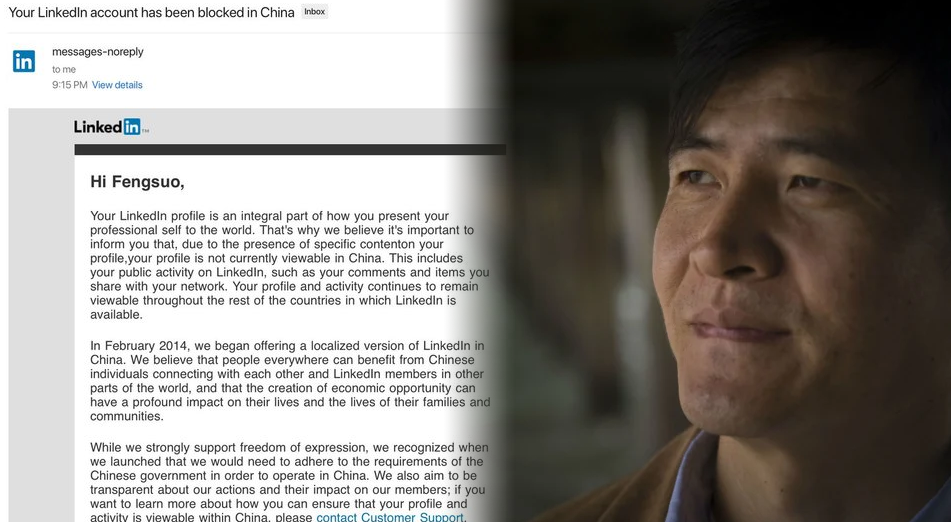
Humphrey isn’t the first case of LinkedIn censoring profiles in China either, which makes Leverich’s explanation seem quite farfetched indeed. Pro-democracy activist Zhou Fengsuo has also had his profile blocked in China as well.
Both activists and their struggles are being censored in China, and when US owned companies like LinkedIn comply with censorship demands it only makes the problem worse. It means that they are compliant with blocking freedom of speech and proliferating the corrupt regime in China.
In order to operate in China, LinkedIn must comply with government requests, which means that it is putting its integrity at stake in order to keep their profit model in the country. Due to their compliance, it is not surprising to see that it is one of the few social networks that still works in China–unlike YouTube, Twitter, Facebook, or hundreds of other platforms. LinkedIn’s explanations that activist profiles have been accidently blocked is laughable. Since they work in China, it’s easy to see that they are working with China, and their explanations are only public relation lies. One must wonder why LinkedIn doesn’t trust drop the facade and admit openly that they openly comply with Chinese demands of censorship.