


TorGuard VPN has had a great year so far introducing a ton of new features and integrations. We’ve updated design elements on the main TorGuard client, and in terms of security, we’ve implemented the new OpenConnect protocol that is delivering some of the fastest VPN speeds worldwide to places that normally can’t use VPN.
These are only some of the updates we’ve done this year, but we aren’t done yet. Now we’re introducing a brand new OpenVPN 2.4 update that increases speeds and provides more port/authentication options.
We are also improving Stealth VPN through OpenVPN 2.4 to help international users stay connected to the web securely.
Finally, the new update includes bug fixes and security improvements to make TorGuard more stable and even more secure.
OpenVPN 2.4 Update
Our new OpenVPN 2.4 update brings a ton of new features to TorGuard in terms of customizability and usability.
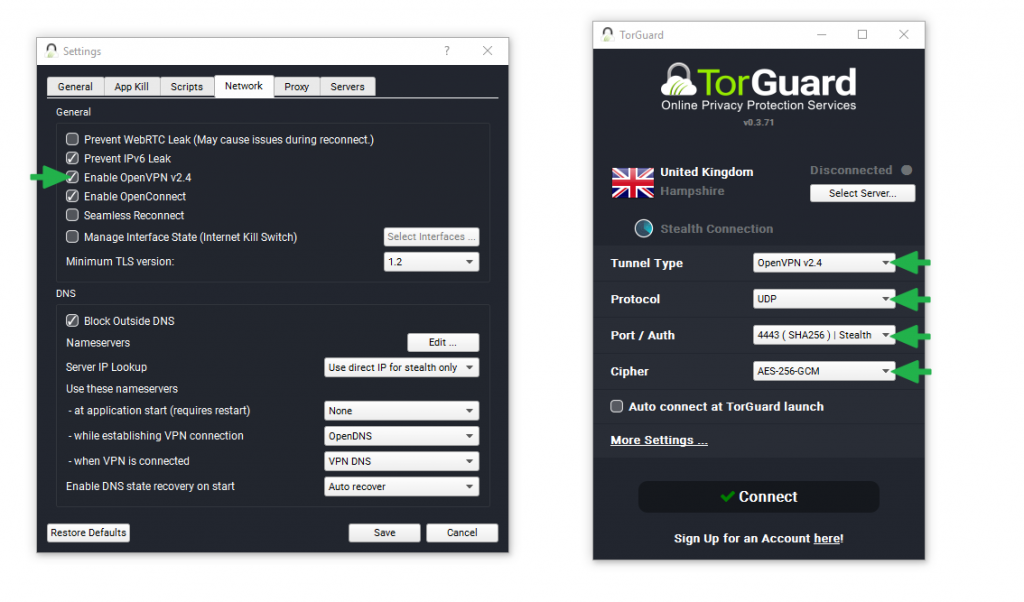
In terms of cipher options, you can now pick from BF-CBC, AES-128-GSM, AES-256-GSM, AES-256-CBC, AES-128-CBC.
We’ve also included new port and authentication options for OpenVPN v2.4 like 443 (SHA1), 80 (SHA1), 995 (SHA1), 1912 (SHA256), 1195 (SHA256), 1215(SHA512), 389 (SHA512).
There is also a brand new updated OpenVPN Stealth obfuscation port / authentication option with 4443 (SHA256) Stealth.
How to use OpenVPN 2.4
In order to activate OpenVPN 2.4, go to the settings in the TorGuard VPN app. From here, select the “Network” tab, then check the box that says “enable OpenVPN 2.4”. Now, restart the app, and click on the “Tunnel Type” drop down menu and select OpenVPN v2.4.
By running the GCM cipher options, you will notice an increase in speed and VPN router users can also expect an increase in speed when running OpenVPN GCM ciphers.
Why use Obfuscation?
With Stealth VPN obfuscation active, you can use VPN in places that normally restrict it. Hospitals, schools, universities, workplaces, and hotspots like Starbucks often unnecessarily restrict VPN use. Or, if you live in a country like Turkey, Egypt, Iran, Saudi Arabia and the United Arab Emirates (UAE), or any other country that restricts basic VPN ports, you can still use Stealth VPN since it appears like normal HTTPS traffic, or regular internet use.
While Stealth VPN is great for unblocking VPN restrictions, it can also be used to increase download speeds since it uses different ports. ISPs around the world actively shape and monitor bandwidth to save bandwidth by monitoring and controlling traffic used via specific ports like ports 22, 53 and 443.
What is cipher negotiation?
Cipher negotiation was introduced with OpenVPN 2.4. The main idea is that with cipher negotiation, you can choose which encryption cipher you want to use.
If for example, you want to use a device with low CPU power (like a Raspberry PI) you can use lower encryption rates by choosing a cipher like AES-128-GCM, or if you’re using a powerful machine, you can use higher encryption rates and choose a cipher like AES-256-GCM.
Depending on your device’s processing power, and intended purpose for using VPN (if you want to stream, perhaps lower the rate and change to a weaker cipher) you can improve performance by negotiating your cipher.
Stealth VPN Improvement Update
This year has been a tough year for VPN and encryption at large. Many states and countries are cracking down on encryption trying to dismantle it by blocking VPN connections or blocking access to VPN websites.
Many countries are working to decrypt messaging apps, and deny access to VPN by removing VPN apps from app stores.
Only just a few days ago Egypt starting blocking OpenVPN, and we reported earlier this year how China removed most non-government complaint VPNs entirely.
TorGuard still stands vigilant against the anti-encryption crusade. This new Stealth VPN update introduced with the OpenVPN 2.4 update, makes Stealth VPN even more secure.
Difference between OpenConnect Stealth VPN and OpenVPN Stealth VPN?
You can pick from our traditional Stealth VPN OpenVPN obfuscation, or you can pick from our new OpenConnect SSL VPN service. Think of OpenConnect like “Super Stealth VPN”.
Our OpenVPN Stealth VPN obfuscation is the more widely used option with more authentication and port options, whereas our OpenConnect Stealth VPN option can bypass even the most strict VPN blockades and restrictions like in China.
