

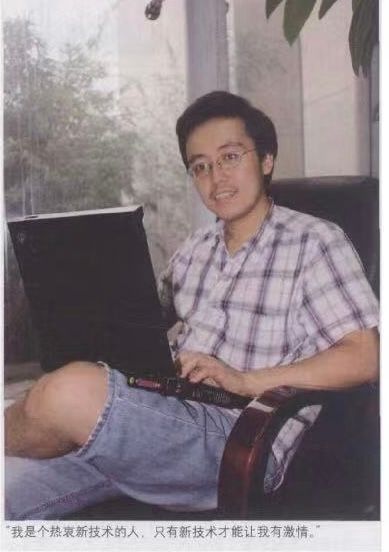
In a world where freedom of expression is often taken for granted, there are still those who risk everything to make their voices heard. Ruan Xiaohuan, the Chinese blogger behind the pseudonym "Program Think," is one such individual. Despite the Chinese government's efforts to suppress information and silence dissent, Ruan persisted in shining a light on the darker corners of Chinese society. His story, and that of his wife, are an inspiring testament to the power of perseverance and the importance of speaking the truth, even in the face of overwhelming odds.
Early Life and Education
Ruan Xiaohuan's journey began when he met his future wife, Bei, in the late 1990s at the prestigious East China University of Science and Technology in Shanghai. Both were studying chemical engineering, drawn together by their shared passion for learning and intellectual curiosity. However, during their final year, Ruan made a bold decision to drop out and pursue his true passion: computer science and information technology. This decision would later prove instrumental in shaping his life and his future as a blogger.
Despite not completing his degree, Ruan's innate talent and dedication to his craft opened doors for him in the world of cybersecurity. Over the next decade, he held executive positions at some of China's top firms in the field, including network security company Venustech. His skills were highly sought after, and he played a key role in overseeing the information security system for the 2008 Beijing Summer Olympics.

In 2012, Ruan made another courageous decision, choosing to leave the corporate world behind. He felt that research in companies was often limited by considerations of profitability, which stifled his creativity and desire for innovation. Instead, he opted to stay at home, dedicating his time to developing open-source software and immersing himself in the world of news and literature. This period of self-directed learning and exploration would eventually inspire Ruan to create the "Program Think" blog, setting the stage for the remarkable journey that lay ahead.
The Beginnings of "Program Think"
Driven by a desire to expose the truth and inspire change, Ruan began writing a blog under the pseudonym "Program Think" in January 2009. Initially focused on programming and software development, the blog's content soon expanded to cover other areas as Ruan grew increasingly frustrated with the censorship in China. In June 2009, he declared, "I don’t want to stay silent and avoid these issues anymore. It’s time to write about things other than technology."
From that point on, Ruan's blog took a different trajectory, covering a wide range of topics from history and psychology to cybersecurity and politics. Despite the escalating risk under China's intensifying repression of dissent, Ruan remained committed to his writing, pledging never to stay offline for more than 14 days at a time.
Over the years, Ruan's blog offered a unique blend of technical cybersecurity advice and sharp political commentary, providing tips on safely navigating China's internet censorship using VPNs, developing critical thinking, and resisting the increasingly totalitarian rule of the Chinese Communist Party. Ruan took pride in his ability to cover his digital tracks and avoid capture, even as more government critics fell victim to Chinese leader Xi Jinping's crackdown on dissent. His comprehensive collection of resources inspired many Chinese social media users, who credit "Program Think" for their political awakening.
Ruan's writing boldly explored even the most sensitive topics in China, such as the Tiananmen Square massacre. In 2013, he won Deutsche Welle's Best of the Blogs Award and explained his motivations, stating that all major problems in the country could be traced back to China's political system and crony capitalism. He believed that the only way to break their dominance was through a nonviolent revolution, which is why he devoted his time to content that could improve people's political and psychological awareness.
Despite receiving Gmail alerts of government-backed attacks and dealing with pro-government trolls spamming his comment section, Ruan remained defiant. He cited Friedrich Nietzsche, saying, "What does not kill me makes me stronger." When concerned readers urged him to leave the country for his safety, he responded with a line from V for Vendetta: "If all those who dare to resist run away, they would win."
"If all those who dare to resist run away, they would win."

The Cat and Mouse Game with Chinese Authorities
On May 10, 2021, one day after "Program Think" published its final blog post, police arrested Ruan at his Shanghai home. Authorities have not disclosed how they tracked him down, but in the two years of silence that followed, Ruan's followers have been trying to figure out what happened to him. A social media user managed to trace "Program Think"'s public Gmail account to a corporate email once used by Ruan, which might have been how authorities found him.
Ruan's detention caught his wife, Bei, by surprise. She had no idea her husband was blogging about politically sensitive subjects. Upon learning about his case's severity, she could not comprehend how her tech-obsessed husband could have the energy to write articles on current political affairs.
Throughout the investigation and court procedures, Bei was unable to learn much about her husband's case, as authorities claimed it involved "state secrets." Ruan was tried in secret, and Bei only saw him again at his sentencing at the Shanghai No. 2 Intermediate Court on February 10th. She described him as "abnormally thin," with hair that had turned almost all white. After the sentencing, Bei noticed Ruan's expression of dissent and need for help, prompting her to encourage him to appeal.
According to a copy of the verdict, the court ruled that Ruan had "long harbored dissatisfaction" with China's political system and social governance. They claimed he had written over a hundred seditious articles inciting subversion of state power and intending to overthrow the socialist system. However, the court documents did not mention the name of Ruan's blog or provide details on the content deemed subversive.
Determined to uncover what authorities had withheld from her, Bei learned to use a VPN to bypass China's strict internet restrictions. Her search for missing Chinese bloggers led her to a blog with a picture of Rodin's sculpture "The Thinker" as its avatar – "Program Think." The timing, content, and writing style of the blog all matched up with her husband's background, leading Bei to conclude that Ruan was indeed "Program Think." This realization brought her to tears, as she considered the immense pressure he must have been under for such a long time.

Understanding the sensitivity of her husband's case, Bei sought human rights lawyers to represent him in his appeal trial. However, she faced the same challenges as her husband in confronting China's security apparatus. When she tried to meet with two well-known human rights lawyers, Mo Shaoping and Shang Baojun, police officers cornered her in her apartment building and pressured her for hours to drop the case. Mo and Shang were eventually blocked from representing Ruan, and authorities appointed two lawyers in their place, claiming Ruan had requested legal aid.
As Ruan's second appeal approached, Bei decided to speak up, seeking to ensure a fair trial through public opinion. On Chinese social media platforms, Ruan's name and even subtle references to "Program Think" have been censored. But outside China, there has been a surge of concern, with many users leaving comments on his blog and archiving his content. One commenter wrote, "A true hero. May you live till the day they all go up in smoke."
Passing The Torch
Chinese authorities have never publicly acknowledged "Program Think," but many Chinese rights activists, China experts, and blog followers believe Ruan is the missing blogger. International rights groups, such as PEN America and Human Rights Watch, have also connected Ruan to "Program Think" and demanded his immediate release.
Zhou Fengsuo, a 1989 Tiananmen movement student leader and Executive Director of Human Rights in China, believes the official secrecy surrounding "Program Think" reveals authorities' fear of the blogger's influence. Zhou highlights that Ruan managed to continue for 12 years under the Communist Party's extensive surveillance. He emphasizes that Ruan could have easily lived a comfortable life, but instead chose to use his expertise to promote freedom, influencing hundreds of thousands of people.
Drawing inspiration from the Olympic tradition of passing the torch, it is essential to keep a spotlight on Ruan and draw attention to his story. The more people know about him, his actions, and what he signifies, the safer he will be. In the words of one of his Twitter followers, "You are already a well-deserved hero in the hearts of countless people, and we will live with the torch you ignited."
Ruan Xiaohuan's story, as the man behind "Program Think," exemplifies the power of determination and the unyielding human spirit. His journey highlights the importance of free speech and the need for open dialogue and dissent within a healthy society. Ultimately, Ruan's story transcends one man's fight for justice, serving as a call to action for everyone who values truth, freedom, and the power of the human spirit to overcome adversity. Ruan has lit the flame; now, it is up to each one of us to pass this torch to others.