

Following Apple’s compliance with Chinese law to remove VPN apps that allow users to unblock censored content, users everywhere around the world–Chinese or otherwise, have been understandably upset.
Here at TorGuard, we pride ourselves on being a beacon of hope for privacy and anonymity–a way for users around the world to unblock censored content and enjoy a free internet. VPN is important–nay mandatory, for users that once thought their internet experience would forever been hindered, or just a collection of government approved propaganda websites.
VPNs also have other uses as well like protecting user anonymity and security from hackers in public Wi-Fi spaces. Without easily accessible VPNs like TorGuard, users might forego VPN protection altogether causing more identity theft, leaked passwords, and stolen bank account information. This is why when Apple complied with China to remove TorGuard and other VPN apps from the app store, we were quite upset.
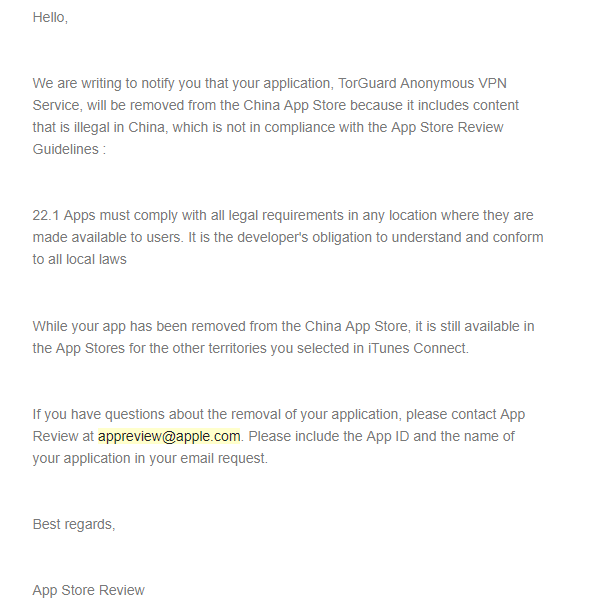
Apple’s letter stating the decision to remove TorGuard VPN apps from China’s iOS app store
Sure, you could argue that if a Chinese user really wants to get access to a VPN like TorGuard, they can simply login to a different country iTunes store and download any app from other countries. Other simple ways to get access to VPN can be achieved by connecting to a TorGuard server through the native VPN settings in your iPhone. Just navigate to your “Settings”, tap “VPN” and add a VPN configuration through IKEv2. You can find more detailed instructions here.
However, these extra steps shouldn’t be necessary, and a large amount of new VPN users in China might not know about VPNs in the first place to take these steps, which is China’s main goal. In the same way that China censors history and events, China also wants to censor VPNs by just removing them altogether.
So what was Cook’s reasoning? Well, it was pretty simple. Tim Cook removed VPN apps from the Chinese app store according to law.
“We would obviously rather not remove the apps, but like we do in other countries, we follow the law wherever we do business. We strongly believe that participating in markets and bringing benefits to customers is in the best interest of the folks there, and in other countries as well. We believe in engaging with governments, even when we disagree. In this particular case, back to commenting on this one, we hope that over time, the restrictions we’re seeing will be loosened, because innovation requires freedom to collaborate and communicate, and I know that is a major focus there. That’s sort of what we’re seeing from that point of view. Some folks have tried to link it to the US situation last year — they’re very different. In the case of the US, the law in the US supported us. It was very clear. In the case of China, the law is also very clear there, and like we would if the US changed the law here, we would have to abide by it in both cases. That doesn’t mean we don’t state our point of view, in the appropriate way — we always do that. “
It’s obvious that Tim Cook understands the importance of this issue, but it’s less clear on why Apple responded the way they did. Some critics speculate that it had something to do with Apple’s grip on China getting smaller, due to companies like Xiaomi, Huawei, and Oppo pulling ahead. Perhaps if Apple complies with the government in the same way that Chinese companies do, the phones might sell better.
If they removed the apps for China, will they remove any app that a government requests in any country? Say Russia wants to pull all VPN apps from the Russian app store. Or maybe Australia wants to further their war on encryption and remove encryption apps like VPNs and private messaging apps from the iOS store. This sets a dangerous precedent for sure.
This VPN app removal process also begs the question if native VPN support could be potentially ripped out of iOS if a country manages to get it’s hands on the OS itself. After All, the app store is a native part of an iPhone and the apps are what power it. It doesn’t seem like too much of a stretch for me for Apple to create custom settings and configurations for iPhones sold in countries that prohibit most anonymous VPN use like in Russia and China.
