

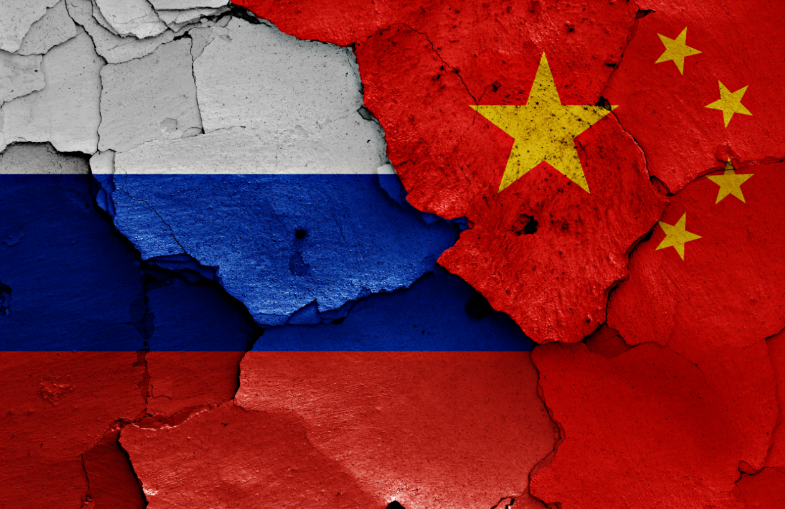
For a long time, The Kremlin underestimated the Internet’s political and social power, and didn’t bother trying to control it. Yet, now worried by Twitter and Facebook’s potential for mobilization, especially after the Arab Spring and the strong protests against Vladimir Putin in Moscow in 2011, the authorities are searching for a solution to the “Internet problem”. Just last month, the Internet helped spark Russia’s largest anti-government protests in five years, and the Russian government retaliated by blocking access to the websites that promoted protests and demonstrations. The Kremlin is working hard to find a way to get social networks under control, and is drawing inspiration from the way China handles their own internet matters.
Online freedoms in Russia are at great stake. Many analysts seem to believe the Kremlin is slowly trying to move towards the same type of online censorship as the one currently used by the Chinese government. Not so long ago, as recently as 2010 in fact, Russians could enjoy a relatively vast online freedom. However, a law that took effect in late 2012, to give just one example, granted Russian authorities the power to block certain online content, marking the beginning of a change in the way Putin’s government handled the whole internet situation in the country. At the time, opponents warned that this law was likely to open the door to greater online censorship. They have been proved right: Russian authorities are now showing signs that suggest the country is making the transition into a more Chinese model of internet control.
The strategy the Kremlin initially came up with was based on intimidation, rather than technology. Accustomed to dealing with specific hierarchies and organizations, authorities chose to put pressure on companies rather than users by directly targeting tech giants’ bosses and forcing them into a private dialogue with the government. Companies such as Yandex and Google rushed to the Kremlin to talk and come to terms when they found the continuity of their service was becoming endangered by the constantly updated repressive legislation. Initially, this strategy proved to be pretty effective. It didn’t take long then for the Internet companies to let go off their freedom principles and accept a censored Internet in Russia.
It is becoming more and more clear that Russia admires the way China is able to control online access. In fact, Lu Wei and Fang Binxing, both famous for their large contribution to the Chinese online censorship, were asked to take part in an Internet Safety forum in Moscow last year, and demonstrated China’s “Internet Sovereignty” model. Putin then hinted at support for this idea by saying it was natural for all countries to protect their own interests online. Last month, new anti-Government protests sparked in Moscow, and were once again coordinated online. The government’s response was swift this time, and consisted in blocking any sites linked to the protests, which it declared were illegal. It would be hard to deny that this reaction was directly inspired by the Chinese internet manual. Nevertheless, the Chinese Communist Party recognized the potential political threat the internet posed to their control of the country at a very early stage, which means that Chinese people have never actually experienced free and open internet access, unlike Russian citizens. The Kremlin shall soon find that, once you give people Internet freedom, it’s not so easy to completely take it away. Unfortunately, this probably won’t keep authorities from trying to restrain it.
In a recent interview, which was reported by Russia’s Interfax News Agency [in Russian], President Vladimir Putin appeared to approve the Chinese censorship model.
When asked about whether Russia should follow or condemn Chinese online censorship, Putin is reported to have said “We should not criticize what China is doing… China has long since awoken and it is with these processes that it needs to govern.”
Whilst Putin insisted that Russia would follow its “own path” rather than directly mimic the Chinese model, he did comment on the very concept of online freedom.
“Callous quasi-freedom on the internet does not exist anywhere anymore,” he said. “All countries in the world have certain content limitations. We have limitations and they are known… In my view, these limitations are enough at the moment.”
The final three words of the comment suggest more actions are yet to be taken, further worrying online freedom advocates in the country.
While Facebook and Twitter remain accessible in Russia, at least for now, a Russian court ruled to ban LinkedIn in late 2016, saying the platform broke the rules that require companies to store personal data about Russian users within the country’s physical borders. This served as a warning to companies like Google, Twitter, and Facebook, and the services seem to have begun complying with at least some requests from Russian authorities to remove content, meaning they are still available at the moment.
Popular American platforms such as YouTube have become very powerful in Russia in recent years, making them extremely hard for authorities to control. Alexey Navalny, opposition leader and anti-corruption blogger, made allegations in a YouTube video that former President and current Prime Minister Dmitri Medvedev had amassed an immense fortune in yachts, mansions, and estates, which is believed to have in part sparked recent demonstrations and protests in the country after his demand for investigation in the matter was denied by the Russian parliament. The video was viewed more than 16 million times. According to Russian blogger Elia Kabanov, YouTube is now too big to block. “I doubt the Kremlin will go there,” he said. “They blocked LinkedIn mostly because it was a niche site in Russia and nobody cared. And of course the government propaganda machine is using YouTube a lot, so it wouldn’t make any sense to block it.” If the government did try to take down protest announcements on YouTube, Kabanov says, new ones would appear. “I really can’t see the way for the Kremlin to implement the Chinese model now: Everything is too connected, their own agencies are using all these services.”
Russia Internet expert Andrei Soldatov, author of the book The Red Web, says the Kremlin “certainly looks for something close to the China approach these days, mostly because many other things failed — filtering is porous, global platforms defy local legislation, and are still available.” The government seems to be dreaming of having direct control of “critical infrastructure” such as the national system of domain, Internet exchange points, and cables that cross borders. However, Soldatov adds, this approach, which may not even be successful, would be more of an emergency measure than a realistic attempt to regulate the Internet on a day-to-day basis.
Despite the Kremlin’s obvious aggressiveness towards internet freedom of speech, it is worth noting that no government in the world can actually control the flow of information. Even in very repressive countries like China, any user determined to find information can access it through tools such as virtual private networks to bypass censorship measures, and Russia will make no exception. The country has actually seen an ongoing increase of the use of Tor, a browser that can be used to circumvent censorship; proving Russian citizens are not going to let the Kremlin take their internet away that easily.
The Russian government’s desperate attempt to delete an art piece by A.V. Tsvetkov from the internet depicting Vladimir Putin wearing make up in front of the LGBT flag actually sparked a massive online international backlash last week, causing the image to go viral despite it being a few years old; demonstrating once more than the Internet is no territory to be controlled by governmental laws.
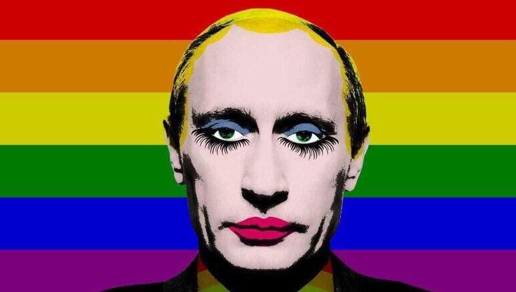
Protesters have used that kind of images of Putin to oppose Russia’s anti-gay laws since 2011. It is now deemed extremist and officially illegal to use and spread such pictures in Russia, which obviously didn’t keep internet users from massively sharing it on social networks. Artwork by A.V. Tsvetkov
