

The internet is a vital tool for communication. It spreads news from one corner of the globe to another. It bridges connections, starts conversations, and helps people mobilize. That’s exactly why Iran’s government decided to shut off the internet amid the escalating protests of outraged Iranian citizens who demand better from their leaders. Removing communication avenues would make it more difficult for people to organize and revolt. Rather than listening to their people, Iran’s government has decided to metaphorically castrate them.
Why Iranians Are Protesting
On the surface, Iran’s protests appear to be regarding the astronomical skyrocketing of gasoline prices. The government imposed a plan that would increase prices by 50% for the first 60 liters of gasoline that citizens utilize each month, and by 300% for each liter more. In a country where most citizens feel the profound impact of poverty, these rate raises price gasoline as a luxury rather than a necessity.
Compounding factors of years of rising tensions between Iranian citizens and the government culminated in the unification of citizens against their government. Feeling stepped on and undervalued in a country that takes no quantifiable measures to protect its poor or create jobs for the working class, pricing them out of a material necessary for their everyday lives lead to an inevitable outrage.
At least 30 Iranian protesters have been killed, and a minimum of 1,000 more have been placed behind bars for their actions during these demonstrations. We may never have access to accurate figures, as the Iranian government’s decision to shut off the internet has throttled any communications incoming or outgoing from the country, putting them at an advantage that allows them to control the narrative and obfuscate the truth.
How the Government Shut off the Internet
Countries that have built their entire infrastructure around government censorship and control of the internet, like China, would have an easy time shutting off the internet. Countries like Russia where infrastructure is being built and recalibrated to allow the same capabilities can also easily block their citizens from the web. Iran didn’t start with censorship and control in mind, but at the eleventh hour, they found a way.
Iran has attempted to build a state sponsored intranet over the past few years. The project has slowly gained prominence but never fully come to fruition. It appears as though Iran is attempting to take the same route as Russia, although they are still several major steps behind in progress.
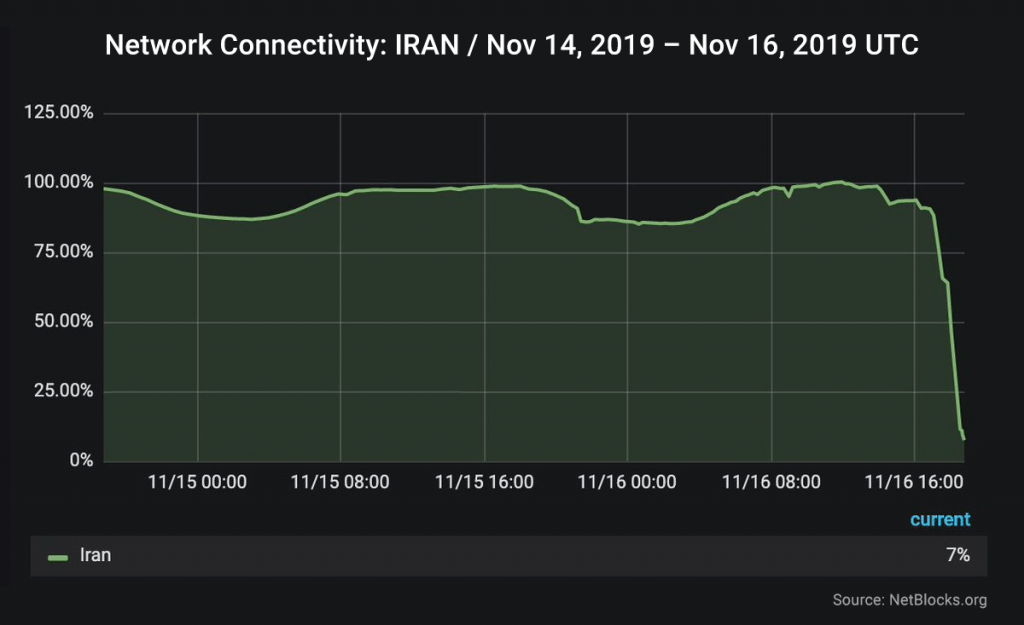
Iran has partially throttled the internet before, but not to the extent of a full blackout. Since the government does not act as a central internet authority, the Iranian government had to work with every single internet service provider and mobile network carrier in the country, manually mandating that they break their own systems to prevent open internet access. The internet service providers complied, leaving 95% of Iranians without any sort of reliable connection.
It is safe to assume that during these internet blackouts, the Iranian government is improving and implementing their intranet structure and preparing to make the definitive switch. This intranet structure would allow the government complete and total control over what citizens can access and will also serve as the ultimate civil surveillance tool.
Censorship in Iran
The Iranian government began blacklisting websites in 2012. Nearly one third of the total internet is blocked in the country, with tell over five million websites blacklisted. It is not uncommon for governments of even free countries to block or restrict some websites. For example, even the most liberal countries work to block content that is objectively harmful, like websites selling illegal narcotics or showcasing child pornography. This isn’t the case in Iran.
Some of these websites seem to be relatively innocuous – things online shopping outlets and sports journalism websites were deemed unsavory by the government. The rhyme and reason isn’t always clear when the Iranian government chooses to give a website the ax, prohibiting citizens from viewing them on the open internet.
While the internet is being slowly restored to some parts of the country, it isn’t being restored without the strict censorship guidelines already put in place by the government.
Achieving Internet Privacy in Iran
The only way blocks and restrictions can be bypassed in Iran is through the use of a stealth VPN. Stealth VPNs make VPN use undetectable by internet service providers, even if the only ISP is the state. This means they cannot be blocked, even if the government decides to make VPN use illegal or restrict their capabilities.
VPNs will allow Iranian citizens to access anything that’s been blocked, whether it’s news, social media, or video streaming service content. No one can see what’s being accessed, so there is no fear of repercussions. The government will not know that the user is viewing, as the VPN creates an impenetrable shield for all internet traffic from the connected device.
Currently, TorGuard VPN’s stealth protocols are fully operational throughout Iran. Citizens are able to access anything and everything without censorship when using TorGuard.