
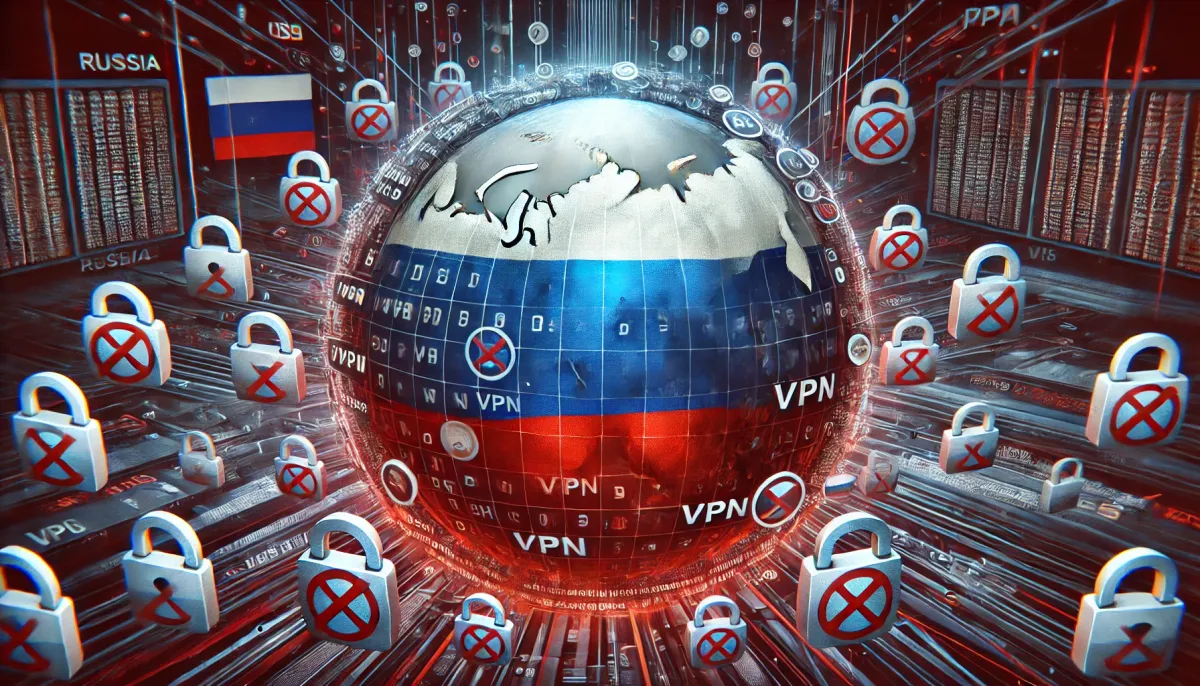
Russia has recently intensified its crackdown on VPNs (Virtual Private Networks), blocking nearly 200 services while simultaneously investing heavily in VPN infrastructure for government purposes. According to Interfax, a state-linked news agency, the Russian government has banned 197 VPN services. At the same time, government expenditure on VPNs skyrocketed, reaching an astonishing 14.1 billion rubles (€134 million) over the first nine months of 2024, as reported by Russian business daily Kommersant.
This paradoxical approach reflects Russia’s unique stance on internet regulation, combining stringent public censorship with robust private use of VPNs for government operations. The implications of this duality extend beyond the country’s borders, prompting concerns about privacy, security, and online freedom.
The Blockade on VPNs for Public Use
Russia’s latest move to block a wide range of VPN services aligns with a multi-year strategy to tighten control over its digital landscape. The country’s media and telecommunications regulator, Roskomnadzor, has been at the forefront of this initiative, which began in earnest in 2021. This year, Sergey Khutortsev, a representative from Roskomnadzor, reiterated that the VPN restrictions are specifically targeting services “used as a means of bypassing blocking.” However, in practical terms, this means banning many VPNs that provide Russian citizens with access to blocked or censored online content.
For everyday users, VPN technology serves as a lifeline for accessing information restricted by the government. It allows users to navigate around firewalls and censorship policies, maintaining access to social media platforms, independent news sources, and international websites that are otherwise inaccessible in Russia. Additionally, VPNs provide essential security, enabling individuals to protect their data from surveillance, which is an increasing concern in highly regulated digital environments like Russia’s.
In March 2024, Russia further tightened its grip on VPNs by criminalizing the sharing of information on circumventing censorship, including using VPN services. This law adds another layer to Russia’s restrictive digital policy, effectively criminalizing tools and methods that facilitate access to blocked information.
Russia’s Surge in Government VPN Spending
While VPN services are rapidly disappearing for Russian civilians, the Russian government has paradoxically ramped up its spending on VPN connections to support official operations. According to Kommersant, government spending on VPN services soared by 683% in 2024 compared to the same period in 2023, reflecting a dramatic increase in demand.
The official explanation for this uptick points to two main factors: the heightened threat of distributed denial-of-service (DDoS) attacks and an intensified need to secure government communications and encrypt sensitive data. Government agencies, especially those tied to critical infrastructure or sensitive operations, require secure communication channels, which VPNs facilitate by creating private networks that are theoretically safer from external threats.
Vasily Danilchik, an expert affiliated with a government procurement agency, clarified that no public contracts specifically aim to procure VPNs for accessing blocked websites. Instead, these purchases are often routed through closed procurement processes intended for government and security agencies, raising questions about transparency and the actual purposes behind these VPN procurements.
Implications of the VPN Ban on Russian Citizens
Russia’s expanding restrictions on VPNs have profound implications for its citizens, who increasingly face limitations in accessing information and exercising digital freedom. Organizations like Freedom House and Reporters Without Borders have consistently ranked Russia among the lowest in terms of internet freedom, and this recent crackdown reinforces the country’s position as a global leader in digital censorship.
For average Russians, this means a growing disconnect from international news, social media, and communication platforms. The restrictions come amid rising censorship since the onset of the Ukraine war, during which the government has intensified efforts to control narratives and suppress dissenting viewpoints. By blocking VPNs, Russian authorities are further isolating the country’s citizens from global perspectives and creating an “information bubble” that could enable greater control over public opinion.
With limited VPN access, internet users may also find themselves more vulnerable to state surveillance, as their online activities become easier to track and monitor. The VPN ban thus contributes to an atmosphere of pervasive surveillance, where users are increasingly conscious of the government’s watchful eye on their digital presence.
The Double Standard in Government VPN Usage
Russia’s dual approach to VPNs—restricting public access while bolstering government usage—reveals an intricate paradox. While the Russian state suppresses digital freedom for civilians, it invests heavily in VPNs to secure government operations. This double standard reflects the regime's need to maintain tight control over information flow and data protection while ensuring that sensitive government communications are insulated from prying eyes.
The increased spending on government VPNs, which amounts to over €134 million in 2024 alone, highlights a significant prioritization of cybersecurity and data privacy within government ranks. This spending spree has raised eyebrows as it underscores how Russian authorities are willing to leverage VPN technology to safeguard their interests while denying the same level of security and access to citizens.
Critics argue that this dual policy mirrors the larger trend of online censorship, where state interests override public freedoms. By restricting VPNs for civilians while reinforcing them within the government, the Russian state is solidifying a digital divide that privileges state security over public access to information. This raises ethical concerns about the transparency of the government’s digital policies and the lengths it will go to control online discourse.
The Growing Global Concern Over Russia’s Internet Censorship
The global response to Russia’s internet policies has been largely one of condemnation. Russia’s approach to internet censorship, including its stance on VPNs, has attracted criticism from international organizations advocating for digital rights and freedoms. The restriction of nearly 200 VPN services in Russia marks an escalation in an already tense environment for online freedom, sparking worries that Russia’s practices could encourage similar restrictions in other authoritarian regimes.
Moreover, the ban on VPNs in Russia signals an evolving strategy for authoritarian governments worldwide. By cutting off tools that bypass censorship, these governments can better control the narrative within their borders, suppress dissenting voices, and isolate citizens from outside influence. Russia’s VPN crackdown serves as a case study in how digital tools, once symbols of freedom and connectivity, can be curtailed and repurposed as instruments of control.
As international observers continue to monitor Russia’s internet policies, the call for protecting digital freedom has become louder. Advocates argue that banning VPNs constitutes a violation of basic human rights, such as freedom of information and privacy. By monopolizing VPN technology for government use, Russia is sending a clear message about its priorities in the digital age—namely, that state security trumps individual freedoms.
What’s Next for VPNs and Internet Freedom in Russia?
As Russia’s government tightens its grip on the internet, VPN services may find it increasingly difficult to operate within the country. This push against VPNs is likely to spur the development of new technologies and methods for circumventing censorship, potentially creating a digital arms race between government regulators and tech developers.
For Russian citizens and international businesses, the VPN ban represents a growing obstacle in accessing and sharing information freely. Companies that operate in Russia may face additional challenges in securing communication and protecting data, especially as the government’s grip on internet infrastructure strengthens.
Internationally, Russia’s VPN policies highlight the importance of digital freedoms in a globally connected world. VPN providers, advocacy groups, and governments are likely to respond to this escalation with renewed calls for digital rights protections. For Russia, however, the government’s approach reflects its commitment to maintaining control over digital spaces, signaling that internet freedom within its borders will continue to face significant challenges.
Conclusion
Russia’s simultaneous crackdown on public VPN services and increased investment in government VPNs presents a striking contradiction in the realm of digital freedom and security. By restricting VPNs, the government effectively limits citizens’ access to global information while securing its own communication networks against external threats. This dual policy raises critical questions about privacy, surveillance, and the future of digital freedoms in authoritarian regimes.
As the world watches Russia’s actions, the call for open, secure, and unrestricted internet access remains vital. VPNs, which were once symbols of internet freedom, are now battlegrounds for control in the ongoing struggle between state security and public access. For citizens in Russia and beyond, the evolution of these policies will shape the future of privacy, connectivity, and freedom in an increasingly interconnected digital world.