

Over the past few months, a number of serious security holes have been uncovered in popular Linksys and ASUS routers effecting those running stock firmware provided by the manufacturer. Our staff here at TorGuard would like to explain how these bugs can compromise one’s entire network and how upgrading to a DDWRT or Tomato VPN router can provide near bulletproof security from “firmware gone rouge.”
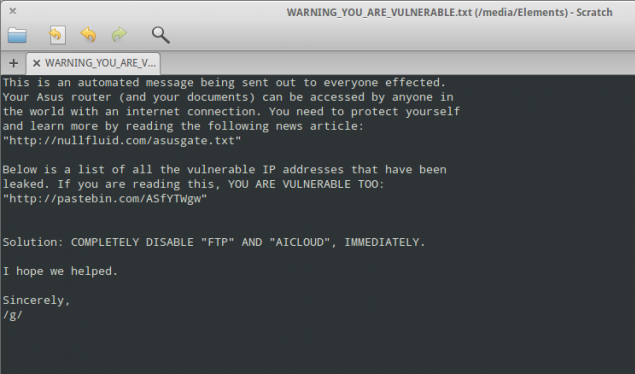
The first example came to light this past weekend after a user reported to arstechnica.com that when browsing the contents of an external hard drive a very mysterious and unnerving file was found. The file warned him that his entire network and files had been compromised by a critical flaw in ASUS firmware:
“This is an automated message being sent out to everyone effected [sic],” the message, uploaded to his device without any login credentials, read. “Your Asus router (and your documents) can be accessed by anyone in the world with an Internet connection. You need to protect yourself and learn more by reading the following news article: http://nullfluid.com/asusgate.txt.”
It is safe to assume that he wasn’t the only person who received this warning, and this isn’t the first ASUS flaw that has been uncovered. Just a few weeks ago an unknown group published a list of 13,000 users running stock ASUS firmware who are victim of a similar security flaw. Looking back even further, a security researcher by the name of Kyle Lovett published his findings of massive stock firmware security issues in heavy duty ASUS routers: RT-AC66R, RT-AC66U, RT-N66R, RT-N66U, RT-AC56U, RT-N56R, RT-N56U, RT-N14U, RT-N16, and RT-N16R.
ASUS is by no means alone in this new round of security vulnerability findings. Manufacturers D-LINK, Netgear and Linksys have all had their own share of similar and repeated issues with a wide range of routers like the n600 (Netgear) and E1000, E1200, and E2400 (Linksys).
Hardware manufacturers are quick to sweep issues like this under the rug and release firmware updates, but does this really fix the problem at hand? Many researchers like Lovett have argued that there are a large number of routers that continue operating without receiving an update. With new bugs being uncovered with such frequency it becomes difficult for the average person to stay informed and keep a router up to date.
Stay Safe with DDWRT & Tomato Firmware

At this point, you may be wondering why does TorGuard still sell Linksys, Netgear, and ASUS VPN routers even after all these security holes have been uncovered? The reasoning is simple: TorGuard flashes all routers with the latest versions of DDWRT and Tomato firmware, erasing the manufacturer’s previously installed stock firmware. Users who are running these flashed or “upgraded” DDWRT and Tomato VPN routers will remain un-effected by these recent security flaws. Not to mention, they sleep a lot better at night.
DDWRT and Tomato firmware are open source and heavily tested firmware solutions that come under the scrutiny of the entire networking community. With so many different individuals constantly reviewing and updating the same code base, it would be virtually impossible for a massive security hole to accidentally be included in a release. Compare this consistent security track record to the slew of recent hacks on stock ASUS, Linksys, and Netgear firmware and it becomes clear why so many people choose DDWRT or Tomato.
All TorGuard VPN routers come shipped pre-flashed with DDWRT or Tomato and pre-configured with OpenVPN service so setup is virtually plug and play! Each router comes with complimentary remote tech support at no extra charge. Checkout the most popular VPN routers of 2014: the Netgear R6300, Linksys e4200, Buffalo WZR-600DHP and ASUS RT-N66U