

Looking for the best VPN protocol? Here’s the quick answer:
- WireGuard: Best for speed and performance. Ideal for streaming, gaming, and large downloads.
- IKEv2: Best for mobile users. It reconnects quickly when switching networks and is great for stability.
- OpenVPN: Best for flexibility and security. Works well in restrictive environments and supports extensive customization.
Quick Comparison Table:
| Protocol | Best For | Key Strengths | Limitations |
|---|---|---|---|
| WireGuard | Speed & Performance | Fast, lightweight, modern cryptography | Requires customization to disable logs |
| IKEv2 | Mobile Stability | Quick reconnection, built-in on many devices | Limited transparency in some cases |
| OpenVPN | Security & Compatibility | Highly configurable, bypasses firewalls | Slower speeds, complex setup |
Each protocol has unique strengths, so the right choice depends on your needs. Keep reading to learn more about how they compare in speed, security, and compatibility.
What is the best VPN protocol? (WireGuard, OpenVPN, IKEv2)
OpenVPN, WireGuard, and IKEv2 Overview
Each VPN protocol is designed with a specific purpose in mind, making each one ideal for different use cases.
OpenVPN: Flexible and Reliable
OpenVPN is often considered the benchmark for VPN protocols. As an open-source solution, it offers extensive configurability and works seamlessly in almost any network setup. Its ability to navigate complex networks, bypass firewalls, and operate across multiple platforms makes it a versatile choice. OpenVPN leverages the OpenSSL library and supports various encryption algorithms, giving network administrators the freedom to customize security settings to fit their needs.
This protocol shines in scenarios requiring secure remote access, IoT communications, SaaS application protection, site-to-site connections, and enforcing zero-trust environments [6][9]. It is compatible with all major platforms, but its large codebase can make audits challenging and may impact performance.
WireGuard: Fast and Streamlined
WireGuard focuses on speed and simplicity, earning high praise from industry experts, including Linus Torvalds.
"Can I just once again state my love for it [WireGuard] and hope it gets merged soon? Maybe the code isn't perfect, but I've skimmed it, and compared to the horrors that are OpenVPN and IPSec, it's a work of art."
– Linus Torvalds, Principal Developer of the Linux Kernel [5]
With a compact 3,800-line codebase compared to OpenVPN's 600,000 lines, WireGuard is much easier to audit [4]. Performance tests show it is, on average, 57% faster than OpenVPN, with some implementations achieving speeds up to 755 Mbps [4]. It uses cutting-edge cryptographic tools such as ChaCha20 for encryption, Curve25519 for key exchange, and BLAKE2s for hashing, delivering both strong security and high efficiency.
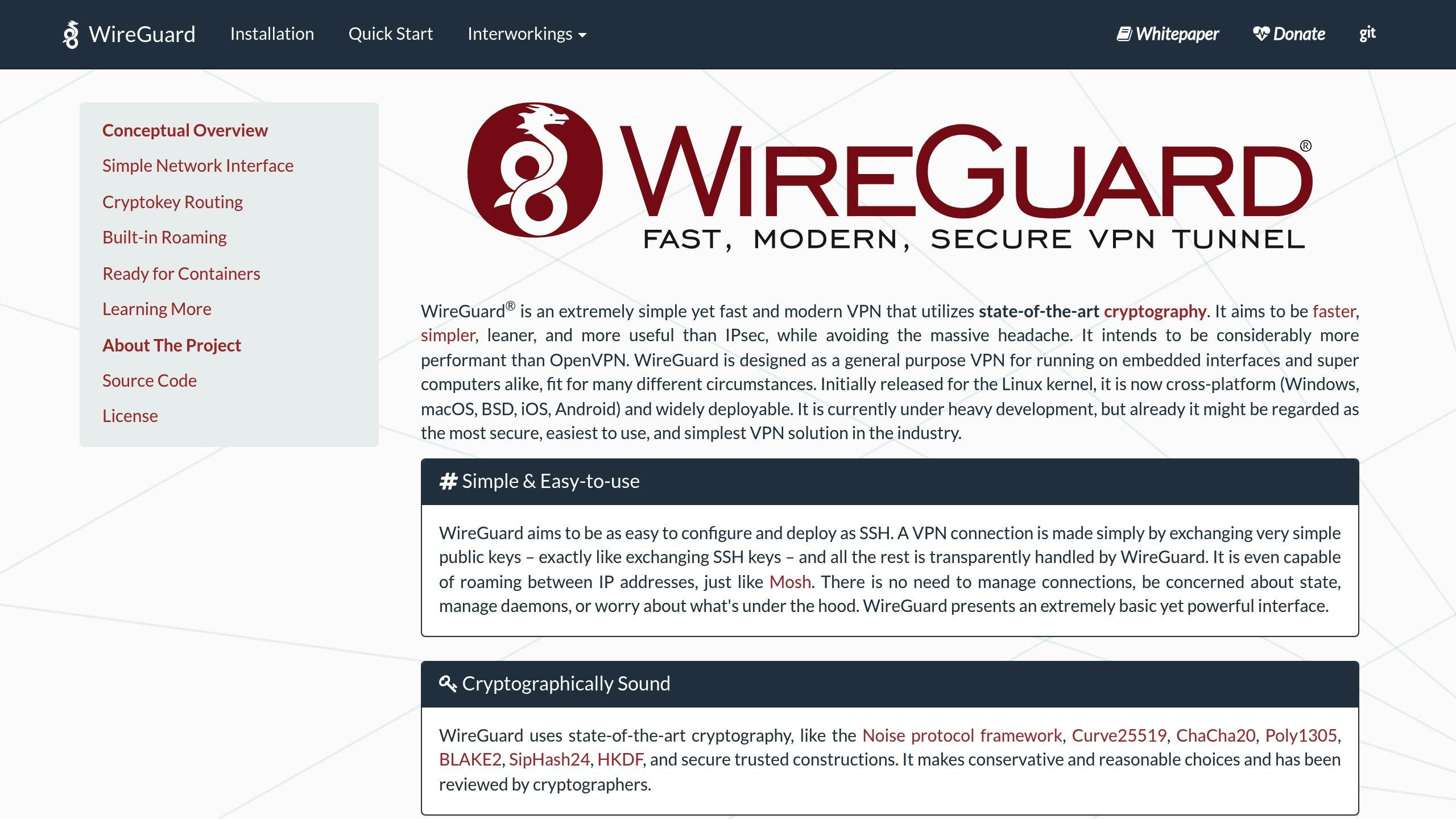
"WireGuard® is an extremely simple yet fast and modern VPN that utilizes state-of-the-art cryptography. It aims to be faster, simpler, leaner, and more useful than IPSec, while avoiding the massive headache. It intends to be considerably more performant than OpenVPN."
– WireGuard Home Page [5]
WireGuard is particularly suited for performance-critical scenarios like IoT applications, streaming, and gaming, where traditional VPNs might struggle [7].
IKEv2: Stable and Mobile-Friendly
IKEv2 (Internet Key Exchange version 2) is known for its stability, especially in mobile environments where network conditions often fluctuate. It is designed to maintain session stability even during network transitions, making it a favorite for mobile users [8].
Using AES encryption with Perfect Forward Secrecy and Diffie-Hellman key exchange, IKEv2 ensures secure connections with rapid reconnection times. This makes it an excellent choice for mobile users and enterprise environments where consistent connectivity is essential. However, its reliance on non-standard UDP ports can lead to firewall restrictions in some cases.
| Protocol | Core Strength | Primary Use Cases | Key Technology |
|---|---|---|---|
| OpenVPN | Flexibility & Wide Compatibility | Enterprise networks, complex setups, high-security environments | OpenSSL library, certificate-based authentication |
| WireGuard | Speed & Modern Efficiency | Streaming, gaming, mobile devices, performance-critical applications | ChaCha20, Curve25519, minimal codebase |
| IKEv2 | Stability & Mobile Optimization | Mobile users, enterprise environments, network transitions | AES encryption, Diffie-Hellman, fast reconnection |
Each protocol reflects a distinct approach to VPN design. Understanding these differences is key to evaluating their performance and security in various scenarios. Up next, we’ll explore how these protocols perform in real-world applications.
Performance Comparison
VPN performance - measured through speed, latency, and reconnection times - plays a critical role in activities like streaming, gaming, and video calls.
Speed and Data Transfer
When it comes to speed, WireGuard is the clear leader. Independent tests reveal that WireGuard outpaces OpenVPN by about 57% across various server locations. Top VPN services using WireGuard deliver speeds between 300 Mbps and 445 Mbps on a 500 Mbps internet connection [12]. This impressive performance stems from its lightweight structure and modern cryptography, which is integrated directly into the operating system kernel.
IKEv2 also offers strong performance, particularly for mobile users. While it doesn't match WireGuard's top speeds, it often surpasses OpenVPN, thanks to its efficient design. OpenVPN, by contrast, relies on user-space encryption, which can introduce extra overhead and slow things down.
OpenVPN delivers moderate speeds. In UDP mode, it can perform similarly to IKEv2 on stable networks. However, its larger codebase and greater configurability can compromise raw speed compared to newer protocols.
| Protocol | Speed Performance | Typical Speed Range | Best Use Cases |
|---|---|---|---|
| WireGuard | High | 300–445 Mbps | Streaming, gaming, large downloads |
| IKEv2 | Moderate | Good mobile performance | Mobile browsing, video calls |
| OpenVPN | Moderate | Reliable baseline | General browsing, secure access |
Next, let’s look at latency and stability, crucial for real-time applications.
Latency and Connection Stability
Speed isn’t the only factor - low latency and stable connections are just as important for real-time activities. WireGuard stands out here as well, maintaining low ping times due to its streamlined code and minimal overhead. This makes it a favorite for competitive gaming, where every millisecond counts.
IKEv2 excels in mobile environments, where network conditions can change frequently. Its built-in stability features ensure smooth performance even when switching between Wi-Fi and cellular connections, making it ideal for users on the go.
OpenVPN UDP offers a balanced approach. While its latency is slightly higher than WireGuard, it delivers consistent stability across various network conditions. This makes it a dependable choice for streaming and moderate gaming, where ultra-low latency isn’t as critical.
Reconnection Times
When it comes to reconnecting after a network interruption, IKEv2 and WireGuard both shine. Their ability to reconnect quickly is especially valuable for mobile users frequently switching between networks.
OpenVPN, however, takes longer to reestablish connections after interruptions. While this isn’t a major issue for desktop users on stable networks, mobile users may experience delays when switching networks or recovering from signal drops. This can impact productivity, especially for remote workers.
Each protocol’s performance reflects its design priorities. WireGuard focuses on speed and efficiency, IKEv2 emphasizes mobile stability and quick recovery, and OpenVPN prioritizes compatibility and flexibility. Knowing these strengths and trade-offs can help you pick the best protocol for your specific needs.
Security and Privacy Features
After diving into performance, it’s time to explore the security and privacy measures that set each protocol apart. Security is the backbone of any VPN protocol, and each one has its own way of safeguarding data - whether through encryption techniques or the transparency of its code.
Encryption Methods
OpenVPN offers a lot of flexibility when it comes to encryption, thanks to its use of the OpenSSL library. It supports a range of cryptographic algorithms, including AES, 3DES, RC5, and Blowfish. Most implementations lean on 256-bit AES for stronger protection. While this flexibility allows for customization, it also means careful configuration is crucial to avoid vulnerabilities.
WireGuard takes a different approach, sticking to a streamlined set of modern algorithms. It uses ChaCha20 for symmetric encryption, Curve25519 for key agreement, BLAKE2s for hashing, SipHash24 for hashtable keys, and HKDF for key derivation. This simplicity minimizes configuration errors and reduces potential attack points [16].
IKEv2, like OpenVPN, supports a variety of algorithms, including 3DES, AES, Blowfish, and Camellia. It often relies on AES with 256-bit keys, delivering strong security while also offering better speeds compared to OpenVPN.
In short, OpenVPN focuses on adaptability, WireGuard prioritizes streamlined modernity, and IKEv2 strikes a balance between security and mobility. These encryption methods also play a role in how transparent and auditable each protocol is, as we’ll see next.
Code Audits and Transparency
Transparency is a key factor in security - it allows experts to scrutinize code for vulnerabilities. OpenVPN shines in this area, being open-source and having undergone numerous audits. One of the most notable was conducted by Trail of Bits, a respected security firm, which concluded:
"The audit did not uncover any significant flaws that could impact system confidentiality, integrity, or availability in the time provided" [17].
OpenVPN also enforces a strict review process for changes, requiring multiple developer approvals and rigorous testing.
WireGuard, on the other hand, stands out for its small codebase - about 4,000 lines for its Linux kernel implementation [7]. This makes it much easier to audit compared to OpenVPN’s sprawling 600,000 lines of code [7].
IKEv2, however, often relies on closed-source implementations, which can limit transparency and make independent reviews more difficult [8].
| Protocol | Code Transparency | Audit Status | Lines of Code |
|---|---|---|---|
| OpenVPN | Open source | Extensively audited by Trail of Bits | ~600,000 |
| WireGuard | Open source | Easily auditable | ~4,000 |
| IKEv2 | Often closed source | Limited independent audits | Varies by implementation |
While transparency is a strength for OpenVPN and WireGuard, it doesn’t eliminate all risks, as we’ll explore further.
Security Risks
Each protocol has its own set of challenges. OpenVPN has dealt with vulnerabilities like privilege escalation and denial-of-service risks but has consistently mitigated these issues through timely updates.
WireGuard faces a unique privacy concern. By design, it retains user IP addresses indefinitely [4]. While this doesn’t compromise data within the encrypted tunnel, it raises questions about how user metadata is handled. Many VPN providers tweak their settings to address this privacy gap.
IKEv2 is vulnerable to issues stemming from poor input validation during message processing, which can lead to denial-of-service attacks. Vendors frequently release updates to address these problems, making regular maintenance a must.
Ultimately, all three protocols are secure when implemented correctly, but each has its own quirks. OpenVPN demands careful setup and regular updates, WireGuard benefits from privacy-focused tweaks, and IKEv2 relies on vendor diligence to patch vulnerabilities. Choosing the right protocol means weighing these security factors alongside performance needs.
Compatibility and Use Cases
When selecting a VPN protocol, the devices you use and how you plan to use the VPN play a big role in shaping your experience. Beyond performance and security, compatibility and specific needs can help determine the best protocol for you. Each protocol shines in different situations.
Device Support
OpenVPN works on virtually every major platform, but you'll need to install external software to use it. It supports Windows, macOS, Linux, iOS, and Android.
IKEv2, on the other hand, is built into many systems, including Windows 7 and newer, macOS 10.11 and newer, and most mobile operating systems. This built-in support means faster setups and fewer compatibility headaches. IKEv2 also works on routers, making it a versatile choice for various devices.
WireGuard has quickly become cross-platform, supporting Windows, macOS, BSD, iOS, and Android. Originally designed for Linux, it has since expanded to work on a wide range of devices [21].
| Protocol | Native Support | Platform Coverage | Setup |
|---|---|---|---|
| OpenVPN | None | Windows, macOS, Linux, iOS, Android | Requires external apps |
| IKEv2 | Windows 7+, macOS 10.11+, mobile OS | Windows, macOS, Android, iOS, Linux, routers | Built-in, quick setup |
| WireGuard | Varies by platform | Windows, macOS, BSD, iOS, Android | Modern, streamlined setup |
Network Handling
VPN protocols also differ in how they manage network changes, such as switching from Wi-Fi to cellular data. Here's how they stack up:
- IKEv2 stands out with its Mobility and Multihoming (MOBIKE) feature, which keeps connections stable even when switching between networks. This makes it a great choice for people on the go.
- WireGuard is designed for efficiency. Its lightweight structure not only ensures quick adaptation to network changes but also helps conserve battery life on mobile devices.
- OpenVPN is excellent at bypassing firewalls, though it may require more manual tweaks to handle dynamic network conditions compared to IKEv2 or WireGuard.
Best Use Scenarios
Each protocol has its strengths, making them suitable for different needs:
- WireGuard offers unmatched speed, making it perfect for streaming 4K videos, gaming online, or downloading large files.
- IKEv2 is ideal for mobile users and remote workers who need stable connections while frequently switching networks.
- OpenVPN is a reliable all-around option, especially for privacy-focused users and those needing to bypass restrictive firewalls.
Side-by-Side Comparison
A side-by-side look at these protocols reveals key differences in speed, code complexity, encryption methods, device compatibility, and other crucial factors.
Feature Comparison Table
| Feature | OpenVPN | WireGuard | IKEv2 |
|---|---|---|---|
| Speed Performance | Baseline performance | 57% faster than OpenVPN [12] | Generally faster than OpenVPN, especially on mobile |
| Code Complexity | Over 100,000 lines of code [24] | 4,000 lines of code | Moderate complexity |
| Encryption Methods | OpenSSL library with AES, ChaCha20, Blowfish | ChaCha20, Curve25519, Poly1305, BLAKE2 | 3DES, AES, Blowfish, Camellia |
| Native Device Support | Requires external apps | Built-in on modern devices | Built-in on modern devices |
| Platform Compatibility | Windows, macOS, Linux, iOS, Android | Windows, macOS, BSD, iOS, Android | Windows, macOS, Android, iOS, Linux, routers |
| Reconnection Speed | Standard | Much faster than OpenVPN | Quick reconnection with MOBIKE |
| Network Switching | Manual configuration needed | Efficient adaptation | Excellent with MOBIKE feature |
| Battery Consumption | Higher consumption | Optimized for battery life | Moderate consumption |
| Privacy Logging | Minimal logging possible | May retain connection logs | Minimal logging possible |
| Security Auditing | Complex to audit due to size | Easier to audit and deploy | Standard audit complexity |
| Forward Secrecy | Available | Enforced by design | Available |
| Setup Complexity | Moderate | Streamlined | Quick, built-in setup |
| Ideal Use Cases | Baseline | 300–445 Mbps on a 500 Mbps connection | Strong mobile performance |
This breakdown highlights the unique strengths of each protocol. WireGuard stands out for its impressive speed, offering up to 57% faster performance over TCP compared to OpenVPN [2]. Its lightweight codebase makes it easier to audit and deploy, while its efficiency in battery usage adds to its appeal.
IKEv2 shines on mobile devices, thanks to its built-in support and fast reconnection capabilities enabled by the MOBIKE feature. This makes it an excellent choice for users who frequently switch networks or need a stable connection on the go.
OpenVPN, while slower, remains a reliable and highly versatile option. Its broad platform compatibility and extensive customization options make it a strong choice for users who need flexibility across different network environments.
In short, pick WireGuard if speed is your priority, IKEv2 for mobile stability, or OpenVPN for maximum compatibility and adaptability. Each protocol is tailored for specific needs, so the right choice depends on your use case.
Conclusion and Recommendations
Key Findings
Each VPN protocol has its strengths, making them suitable for different needs. WireGuard is the leader in speed, IKEv2 shines in mobile connectivity, and OpenVPN offers unmatched flexibility.
- IKEv2 is the go-to choice for mobile users. Its MOBIKE feature ensures stable connections even during network changes, and its native support on modern operating systems makes setup effortless.
- OpenVPN is the adaptable powerhouse. While it may sacrifice speed due to higher overhead, its ability to bypass firewalls and extensive customization options make it indispensable for users in restrictive environments. Years of use and scrutiny have also solidified its reputation for security.
- WireGuard stands out for its simplicity and performance, delivering lightning-fast speeds with minimal latency.
These findings can help guide your decision based on your specific needs and circumstances.
How to Choose the Right Protocol
Selecting the best VPN protocol depends on your activities, devices, and network conditions. Here’s how to make the right choice:
- For streaming and gaming, WireGuard is the ideal option. Its high speed and low latency ensure smooth HD streaming and responsive gameplay.
- For mobile users, IKEv2 is the best fit. It quickly reconnects when switching between Wi-Fi and cellular networks, making it perfect for smartphones and tablets.
- For navigating restrictive networks or needing flexibility, OpenVPN is the top pick. Its ability to bypass firewalls and extensive configuration options make it essential for regions with heavy censorship or corporate environments with strict network policies.
| Use Case | Recommended Protocol | Primary Benefit |
|---|---|---|
| Streaming | WireGuard | Fast speeds for HD content |
| Gaming | WireGuard | Low latency and stable connections |
| Mobile Use | IKEv2 | Seamless reconnection during network shifts |
| General Privacy | OpenVPN | Secure, versatile, and bypasses firewalls |
Most modern VPN services let you switch between these protocols, so you can test them and find what works best for your setup. This flexibility ensures you can tailor your VPN experience to your specific needs.
Lastly, steer clear of outdated protocols like PPTP, L2TP/IPsec, and SSTP. These are no longer secure and could compromise your privacy [3]. Stick with trusted options like OpenVPN, WireGuard, or IKEv2 for reliable protection and performance.
FAQs
What are the main security differences between OpenVPN, WireGuard, and IKEv2?
Each VPN protocol brings its own set of strengths, tailored to different priorities and use cases:
- OpenVPN stands out for its flexibility and strong security. It uses SSL/TLS for encryption and supports up to 256-bit encryption, making it a reliable option for safeguarding sensitive information.
- WireGuard is all about simplicity and speed. Built with a modern approach, it leverages advanced cryptographic techniques like the Noise protocol framework. Its minimalist codebase not only boosts efficiency but also reduces potential vulnerabilities.
- IKEv2, often used alongside IPSec, shines with its quick reconnection capabilities and robust encryption standards, such as AES-256. This makes it a great choice for mobile users or those frequently switching between networks.
Each protocol has its niche: OpenVPN is versatile and secure, WireGuard is fast and efficient, and IKEv2 excels in mobile reliability and seamless connectivity.
How does WireGuard compare to OpenVPN and IKEv2 in terms of speed and performance?
WireGuard stands out as one of the fastest VPN protocols available today. In practical use, it can deliver speeds up to 75% faster than OpenVPN, all while maintaining much lower latency. It's particularly impressive on mobile devices, offering a smooth, reliable connection even when you're jumping between networks.
IKEv2, on the other hand, is well-regarded for its speed and stability, especially on mobile platforms. However, it typically falls short of WireGuard when it comes to efficiency and CPU usage. Thanks to its streamlined design and dependable performance, WireGuard is a top choice for both personal and professional needs.
What is the best VPN protocol for users who frequently switch between Wi-Fi and mobile networks?
If you frequently alternate between Wi-Fi and mobile networks, IKEv2 is a smart option. This protocol is built to keep your connection steady and uninterrupted during network changes, making it a great fit for people who are often on the move or regularly switch between different internet connections.
One of its standout features is its ability to reconnect swiftly after any interruptions. This ensures a secure and smooth browsing experience, even in areas where network coverage tends to be unreliable. Because of this, IKEv2 is a favorite among mobile users and anyone who values consistent performance in ever-changing conditions.