

Chongqing is a sprawling city in southwestern China with a population of almost 50 million. Recent news indicates that a new VPN ban could be fast approaching direct from the Chinese government. Chongqing could be a testing ground for a nationwide blockade against users trying to use VPNs to scale/circumvent firewall and internet restrictions in the country.
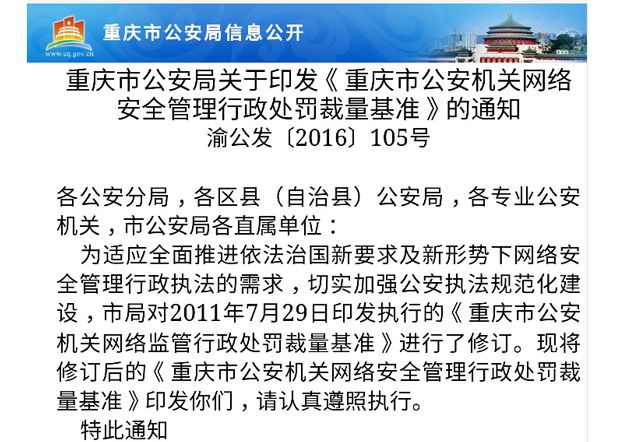
New regulations starting taking affect on March 27, 2017 published on the Chongqing Municipal Public Security Bureau website which shows an announcement prohibiting the use of VPNs to browse online.
This new regulation bans the use of VPN for the city’s 50 million residents. Many users in the city use VPN to get around the Chinese firewall to access world research, social networking sites like Facebook and Twitter, or even just to access public information about the world in Wikipedia. However, any of these sites could contain news that the Chinese Communist Party regards as unflattering.
Activist Ou Biaofeng says that he fears that the implementation of the regulation could foreshadow similar news for the entire nation.”I think that the government is using Chongqing as a testing ground, and then they will apply it to the whole country,” Ou told RFA in a recent interview. “A lot of people use circumvention tools to access information from overseas at the moment,” Ou said. “This is going to spread fear among all those people that climb the Great Firewall.”
Source of VPN Ban?
The regulations on Chongqing com directly from the heart of China, Beijing. The Chinese government wants to control over 731 million internet users and what they can see, post, or use online.
November of 2016 saw new measures that started to ban VPNs to get around censorship in the country. These new measures require websites operating in China to register with a Chinese domain name which subjects the website to Chinese control meaning that said website could be shut down at any time.
Xie Jaye, head of the New York-based Chinese Associate of Science and Technology thinks that the Chongqing regulations are a part of the larger strategy. “These kinds of controls on information will be of no benefit to China’s economic or technological development,” Xie told RFA. “In fact, there are no benefits at all to the kind of control and censorship that the Chinese government exercises over the internet.”
The scary part is that Jaye doesn’t think that these rules will go away anytime soon either since President Xi Jinping will be in power for ten years.
Sophie Richardson, a director at the Human Rights Watch, commented on the issue. “It is unclear whether other local governments will soon follow suit, but the ban has already had a chilling effect among VPN users across the nation—many netizens posted frightened or crying emojis to express their displeasure,” she wrote.
The goal of Chongqing VPN Ban?
So what’s the overall goal of the ban? The government wants to control freedom of expression and government criticism. This way, there won’t be any pressure on the government regarding negative publicity.
Will TorGuard Still work in China?
Yes, TorGuard is verified working behind the great firewall. Since TorGuard offers Stealth VPN technology that lets you use a VPN and appear as regular SSL traffic, there is no way for your VPN to be blocked in China. Although the TorGuard.net website is blocked in China, TorGuard is soon releasing a free signup server on our Chrome and Firefox app to allow Chinese users easy access. More news of this will follow on our Blog and twitter feed…