

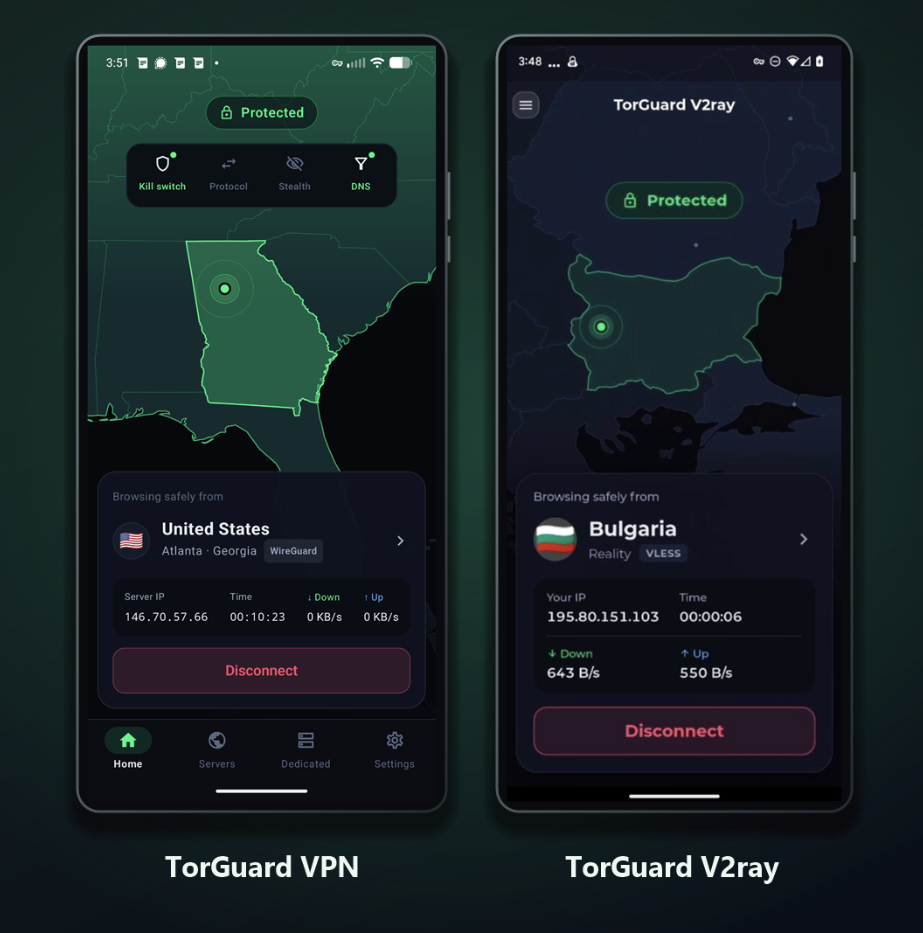
A VPN has to keep up with the way you actually use your phone. You leave home and switch from Wi‑Fi to mobile data. You put your phone in your pocket and the screen goes dark. You come back online after a flight. Those are the moments we focused on when we rebuilt TorGuard VPN for Android.
We also rebuilt TorGuard V2ray, our separate Android app for Xray-based connections. It now tests servers before choosing one and checks that traffic can actually get through before it shows Protected.
TorGuard VPN 2.0
TorGuard VPN 2.0 is in beta and will roll out gradually on Google Play over the coming weeks as an update to the existing app. If you’d like to try it now, you can install the beta directly. Download the TorGuard VPN 2.0 beta APK
TorGuard VPN 1.60 served us for years. By the time we started this rebuild, some of its networking components dated back to 2017. We replaced them with maintained versions, redesigned the app, and reworked what happens when your connection drops or your phone changes networks.
A kill switch built into the app
In the old app, pausing the VPN could let traffic go outside the tunnel unless you had enabled Android’s lockdown mode yourself. TorGuard VPN 2.0 has its own kill switch that holds traffic while the VPN connects, reconnects, or switches networks. You can choose Protect connection, Always on, or Off. The app also blocks IPv6 traffic to prevent it from bypassing the tunnel.
More options for restrictive networks
The new app includes updated WireGuard and OpenVPN 2.7, plus OpenConnect 9.21, which is new to TorGuard on Android. OpenConnect can run over port 443, where its traffic resembles ordinary HTTPS. Scramble, Stunnel, and Stealth Proxy are back, and WebSocket joins them as another stealth option for restrictive networks.
Less time spent picking servers and changing settings
The server list covers more than 60 locations and can sort them by measured speed. Browse the map if you know where you want to connect, or tap Fastest server to let the app pick. Dedicated IPs sync automatically from your TorGuard account and work with WireGuard or OpenVPN. You can also import your own WireGuard configuration.
Split tunneling works both ways. You can keep selected apps outside the VPN or send only selected apps through it. You can connect on boot, use the Android Quick Settings tile, or pause and resume from the notification. If you prefer, the app can pause automatically on mobile data or when the screen turns off. On Android TV, you can do everything from signing in to connecting with your remote.
The app protects sign-in information with Android’s hardware-backed Keystore. It has no ads, analytics, or trackers, and diagnostic logs you send to support mask your username.
Before you update, make sure you’re running Android 8.0 or newer. The app is available in English for now, with more languages to follow. You’ll need to sign in again and set your preferences because settings from the old app won’t carry over.
TorGuard V2ray for Android
The new TorGuard V2ray app will roll out gradually on Google Play over the coming weeks. If you’d like to install it now, you can get the APK directly. Download the TorGuard V2ray APK
TorGuard V2ray runs on Xray 26.11.9 and supports VLESS with Reality, VMess, Trojan, and Shadowsocks. Paste your TorGuard subscription link once and the app loads your locations, grouped by country and city, with live latency. You can also add your own servers from a share link or QR code.
It checks whether the connection works
When you tap a location, the app tests the servers there and chooses the fastest one that responds. Once connected, it checks that traffic can pass through the tunnel. If the server stops responding, the status changes to No connection and you get a Switch server button. The app looks for a working server in the same country first and keeps your traffic blocked while it switches.
The redesigned dark interface puts the live map, connection status, session time, and transfer speeds on one screen. The status card shows the public IP address and country websites see. The app checks both through the tunnel using several independent lookup services, so it can fall back if one is blocked. There’s also a built-in connection report for checking connectivity and latency.
More control over what goes through the tunnel
You can route every app through V2ray, include only certain apps, or exclude the ones you choose. Website rules give you more control over individual sites and IP ranges. Set each rule to use or bypass the tunnel and arrange the rules in the order you want them applied.
The new build targets Android 16, supports devices with 16 KB memory pages, and still runs on Android 7.0 and up. It’s about a quarter smaller to download and asks for fewer permissions. Split tunneling no longer needs access to every installed package.
There are no ads, analytics, or tracking SDKs. The app keeps visited sites out of device logs and excludes server settings from cloud backups and device transfers. It’s available in 13 languages: English, Arabic, Chinese, French, German, Hindi, Japanese, Korean, Russian, Spanish, Thai, Turkish, and Urdu.
Getting started with TorGuard V2ray
- Install TorGuard V2ray using the APK linked above or through Google Play once it’s available to you.
- Copy your subscription link from the TorGuard client area.
- Open the app menu, tap Subscription, paste the link, and tap Save and load locations.
- Pick a location and tap Connect. Android will ask you to allow the VPN the first time.
TorGuard V2ray requires an active TorGuard subscription. If you have questions or run into trouble with either app, get in touch with TorGuard support.