
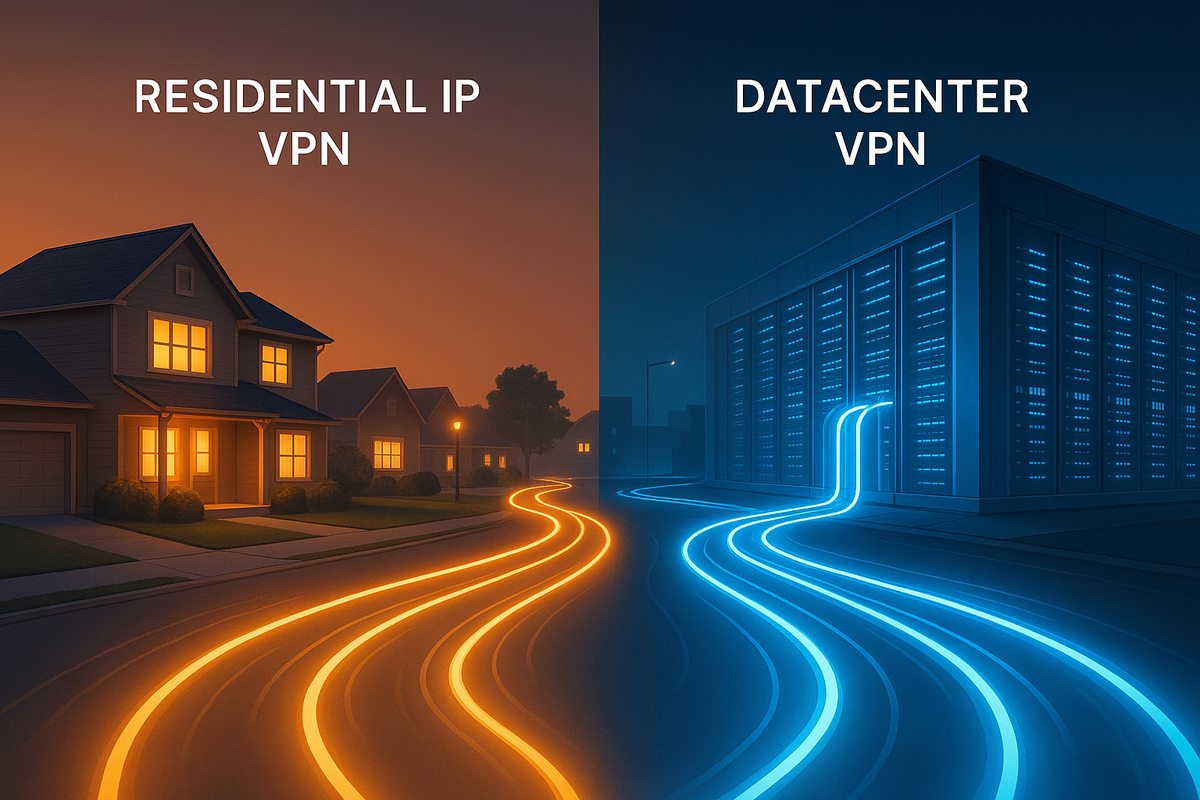
Choosing between a Residential IP VPN and a Datacenter VPN depends on your needs. Residential IP VPNs are better for bypassing geo-restrictions and avoiding detection, while Datacenter VPNs offer faster speeds, lower costs, and consistent performance. Here's what you need to know:
- TorGuard Residential IP VPNs: Use residential IPs from ISPs like Sprint, Spectrum, RCN, Atlas, AT&T, and Windstream. They mimic household traffic, making them harder to detect but more expensive and slower.
- TorGuard Shared Datacenter VPNs: Use commercial hosting IPs. They're faster, cheaper, and better for business use but more likely to be blocked by websites.
Quick Comparison
Feature | Residential IP VPN | Datacenter VPN |
|---|---|---|
Price | Higher | Lower |
Speed | Variable, depends on ISP | Faster and consistent |
Detection Resistance | Better for streaming | More likely to be blocked |
Best Use Case | Streaming, bypassing blocks | Business, gaming, large files |
Key takeaway: Use Residential VPNs for stealth and geo-restricted content. Opt for Datacenter VPNs for speed, reliability, and cost-effectiveness.
How Residential and Datacenter VPNs Work: Core Differences
The way residential and datacenter VPNs operate plays a big role in how they perform. Knowing their key differences can help you decide which one fits your needs better.
Where IP Addresses Come From
Residential IP addresses are provided by traditional internet service providers (ISPs) like Sprint, Spectrum, or AT&T. TorGuard leases real residential IPv4 blocks and fiber in the United States, making them appear as if the connection is coming from a real home. When you use a residential VPN, your traffic is routed through these servers, not through some random residential proxy.
Datacenter IP addresses, on the other hand, come from commercial hosting facilities or cloud providers. These IPs are designed for business use and are managed by entities that handle large-scale operations. Datacenter providers can generate and manage large pools of IP addresses, making them a scalable and efficient option for VPN service.
Detection and Blocking Rates
The origin of an IP address plays a critical role in how websites perceive your connection.
- Residential IPs tend to have lower detection rates because streaming services and content providers often see this traffic as coming from regular home users.
- Datacenter IPs, however, are more likely to be flagged or blocked. Many platforms associate these IPs with VPN traffic, leading to restrictions aimed at enforcing content policies.
These differences impact not only how well these VPNs work for certain tasks but also their availability and pricing in the market.
Availability and Cost in the US Market
The infrastructure behind these VPN types heavily influences their cost and availability.
- Residential VPNs typically cost more. Maintaining real residential connections requires more complex logistics, and the pool of available IPs is limited. Availability can also fluctuate depending on local network demand.
- Datacenter VPNs are usually more affordable. Their automated infrastructure allows providers to offer a steady and abundant supply of IP addresses. These services often maintain extensive server networks across major US cities, ensuring consistent access even during peak times.
Aspect | Residential IPs | Datacenter IPs |
|---|---|---|
Price | Higher | More affordable |
IP Availability | Limited and location-dependent | Abundant and steady |
Setup Complexity | Relies on real connections, more complex | Automated and simpler |
Geographic Coverage | Linked to residential networks | Broad coverage via data centers |
If you need a VPN that mimics a real home connection for better authenticity, go with TorGuard's residential VPN add-on. But if you’re looking for a cost-effective and scalable option, a standard shared data center VPN IP might be the better choice.
Safety and Privacy: Which VPN Type Protects You Better?
When it comes to safeguarding your online privacy, both residential and datacenter VPNs have their strengths, but they function differently and come with distinct challenges. Knowing these differences is key to selecting the right option for your needs.
Risk of Getting Blocked
Residential VPNs have the upper hand in avoiding blocks and restrictions. Websites usually treat connections from residential IPs as legitimate because they mimic regular home internet traffic. This makes them especially effective for accessing content that actively blocks VPN usage, such as streaming platforms. These services often rely on detection tools to block datacenter IPs, but residential IPs tend to slip through unnoticed.
Datacenter VPNs, on the other hand, are more likely to get blocked. Many websites maintain databases of known datacenter IP ranges, making it easier to identify and restrict these connections. This can be a major hurdle for users trying to bypass geo-restrictions or censorship. That said, datacenter VPNs compensate with flexibility - when one IP is blocked, TorGuard can quickly rotate to another, minimizing disruptions.
Beyond blocking concerns, trust levels and anonymity also play a significant role in shaping your privacy experience.
Trust Levels and Anonymous Browsing
The trust factor between residential and datacenter VPNs presents an interesting dilemma.
Residential VPNs are generally more trusted by websites and sensitive platforms. They’re less likely to trigger additional security checks or account restrictions, thanks to their resemblance to standard home internet traffic. However, this trust comes with an anonymity trade-off. Residential VPNs often operate on dedicated connections, meaning less users may route traffic through the same residential IP. This can create additional data trails, as using the same dedicated residential IP across websites makes it easier to correlate user activity.
Shared Datacenter VPNs, by contrast, offer more consistent anonymity controls. Shared VPNs are purpose-built for secure connections, with infrastructure designed specifically for privacy. TorGuard Shared VPN IP's are randomly assigned in each location, and because thousands of users can be assigned a specific IP range at any given time it is harder for ad networks and web analytics to track a user by IP. However, websites may view datacenter IPs with suspicion, leading to more CAPTCHAs, security challenges, or account restrictions - especially for activities like online banking or shopping.
Choosing between residential and datacenter VPNs depends on your priorities. If accessing restricted content is your main goal and you’re comfortable with using the same VPN IP address, residential VPNs will help you bypass website blocks. If you value straightforward privacy controls and anonymity, shared datacenter VPN IP's are the way to go.
Speed and Reliability: Performance Comparison
When it comes to performance, residential and datacenter VPNs differ significantly due to their distinct infrastructures. While safety and privacy are crucial factors, performance plays a key role in shaping the overall user experience. Let’s dive into how these two types of VPNs measure up.
Connection Speed Tests
Shared Datacenter VPNs tend to deliver faster speeds, thanks to their dedicated infrastructure. With optimized routing and dedicated bandwidth, these VPNs ensure consistent performance that’s hard to beat.
On the other hand, residential VPN speeds depend heavily on the quality of the fiber connection. This variability can make them less reliable for activities that demand high bandwidth.
Latency is another critical factor. Datacenter VPNs typically offer lower latency due to their optimized networks, whereas residential VPNs often experience higher latency because they rely on a smaller pool of servers. Additionally, datacenter VPNs maintain more stable uptime since providers have direct control over their infrastructure. Residential VPNs, however, are more prone to disruptions caused by outages or routing issues that may affect residential networks.
Performance for Streaming and Large Downloads
When it comes to streaming and large file downloads, the differences become even clearer. Residential VPNs usually provide enough bandwidth for HD streaming, but occasional buffering is not uncommon. Datacenter VPNs, with their steady and predictable speeds, are better suited for tasks like large file transfers, video conferencing, and other activities where reliability is a must.
Gaming also highlights the performance gap. Datacenter VPNs, with their low latency and direct routing, are ideal for competitive gaming. Residential VPNs, however, may struggle to meet the demands of serious gamers.
Price vs Performance Analysis
The cost structures of these VPNs reflect their underlying setups. Residential VPNs are typically more expensive because of the limited availability of residential IPs and the complexity of managing distributed residential fiber with bare metal servers. Datacenter VPNs, on the other hand, are often more affordable while delivering consistent speed and performance.
Datacenter VPNs strike a balance between cost and speed, though the risk of being blocked by some services may diminish their appeal. For business users, the predictable performance and scalability of datacenter VPNs make them a practical choice. Meanwhile, residential VPNs, despite their higher cost, are often preferred by users who prioritize bypassing geo-restrictions and avoiding detection.
It’s also worth noting that the overall cost of ownership goes beyond subscription fees. The reliability of datacenter VPNs often eliminates the need for backup solutions, while the variability of residential VPNs might push users to subscribe to multiple services to ensure consistent access.
Performance Factor | Residential VPNs | Datacenter VPNs |
|---|---|---|
Average Speed | Variable, depends on home broadband | Higher and more consistent |
Latency | Higher and less predictable | Low and stable |
Streaming Access | Better at bypassing geo-restrictions | More likely to face blocking |
Large Downloads | Can be inconsistent | Reliable and steady |
Cost | More expensive | More affordable |
Business Scaling | Challenging for large-scale use | Better suited for businesses |
Ultimately, the choice between a residential and datacenter VPN comes down to your specific needs. Datacenter VPNs are the go-to option for those seeking speed, low latency, and cost efficiency. Residential VPNs, however, shine when accessing geo-restricted content or overcoming blocks is the priority. These performance differences provide a clear framework for deciding which VPN type is the right fit for you.
When to Use Each VPN Type: Practical Examples
Understanding when to use each VPN type becomes clearer when you look at how they perform in real-world situations. These examples highlight where each type shines.
Accessing Blocked Content and Streaming Services
Residential VPNs are your go-to for bypassing geo-restrictions. Streaming platforms have gotten smarter at identifying and blocking VPN traffic. Residential VPNs manage to sidestep these restrictions since they mimic regular user traffic.
For instance, if you're traveling abroad but want to access your usual streaming library, a residential VPN IP can make it happen. Its IP addresses closely resemble those of everyday users, which makes detection nearly impossible.
On the other hand, datacenter VPNs are a solid choice for accessing general geo-restricted content - like news sites, forums, or educational resources - where advanced VPN detection isn't as common.
Now, let’s see how these VPN types stack up for business use and security.
Business Use and Security Applications
VPNs aren't just for streaming; businesses rely on them for secure and stable connections. Datacenter VPNs stand out for business needs thanks to their consistent performance and scalability. They’re ideal for remote teams, ensuring smooth video calls, fast file transfers, and reliable access to cloud-based tools.
Take a company with 50 remote employees as an example. They all need secure access to internal systems. A datacenter VPN can handle this workload efficiently, maintaining consistent speed and reliability. Plus, its dedicated infrastructure eliminates the unpredictability often associated with residential connections.
Datacenter VPNs also excel at securing sensitive data. Whether it's protecting data transfers, enabling secure communications, or accessing confidential systems, their encryption capabilities provide a dependable foundation for security.
For businesses facing network restrictions, TorGuard's Stealth VPN feature is a game-changer. This technology disguises VPN traffic as regular HTTPS traffic, making it harder to detect. Paired with dedicated IP addresses, it ensures seamless, secure access to business systems from any country world wide.
Additionally, port forwarding options in residential or shared datacenter VPNs cater to specific needs, like hosting secure file servers, running remote desktop connections, or supporting applications with unique network configurations.
TorGuard's Complete VPN Solutions
TorGuard offers flexible plans tailored to different needs:
- The Standard Plan ($10.99/month) gives access to over 3,000 servers in 50+ countries, letting users choose servers based on their requirements.
- For those needing dedicated connections, the Pro Plan ($14.29/month) includes dedicated or residential IP addresses. This setup reduces the chances of being blocked while maintaining steady performance.
- Business users can opt for the Business VPN plan ($32.99/month), which provides tools like user and IP management and dedicated VPN instances. This solution is perfect for companies needing secure, scalable access for their teams.
TorGuard also tackles one of the common challenges of datacenter VPNs with its Stealth VPN technology, which makes traffic undetectable - a critical feature in restrictive environments or heavily censored regions.
With advanced encryption protocols like OpenVPN, WireGuard, and OpenConnect, TorGuard ensures data security across both residential and datacenter-style connections. Combined with a strict no-logs policy, users can trust their privacy is protected.
Switching between server types is seamless. Use optimized servers for streaming geo-restricted content, then switch to high-performance datacenter servers for business tasks or large file transfers. And if you run into any issues, TorGuard's 24/7 support team is there to assist, whether it’s troubleshooting or helping you choose the right server for your needs.
Use Case | Best VPN Type | Key Benefits | TorGuard Solution |
|---|---|---|---|
Streaming Access | Residential | Bypasses geo-blocks effectively | Stealth VPN + global server network |
Business Remote Access | Datacenter | Consistent speed and reliability | Business VPN with dedicated instances |
Large File Transfers | Datacenter | High bandwidth and stability | Pro/Premium plans with dedicated IPs |
Bypassing Censorship | Residential | Appears as regular traffic | Stealth VPN technology |
Gaming | Datacenter | Low latency and stable connections | Port forwarding + optimized servers |
General Privacy | Either | Depends on specific needs | Flexible plans with multiple protocols |
Ultimately, choosing between residential and datacenter VPNs hinges on your goals. But with TorGuard's wide-ranging options, you don’t have to settle. Whether you’re focused on streaming, business reliability, or privacy, TorGuard offers the tools and flexibility to meet your needs.
Conclusion: Picking the Right VPN Plan for Your Needs
Choosing between residential IP VPNs and datacenter VPNs isn’t about finding a one-size-fits-all solution - it’s about aligning the right tool with your specific needs. Each option has its own strengths, and understanding their differences helps you make an informed choice.
Residential VPNs excel in stealth, making them perfect for bypassing geo-restrictions or accessing region-specific content. However, this level of authenticity often comes at the expense of speed and a higher price tag as an add-on service.
Datacenter VPNs focus on speed and reliability. They provide consistent performance, stable connections, and are more budget-friendly, making them ideal for tasks like large file transfers, business use, or general online privacy. The trade-off? They’re more likely to be flagged by advanced detection systems.
When it comes to cost, datacenter VPNs generally offer better value. For instance, TorGuard’s Standard Plan costs $10.99 per month and grants access to over 3,000 datacenter servers in 50+ countries. Residential VPNs, on the other hand, tend to be priced at a premium.
Both options prioritize security with strong encryption. Datacenter VPNs, in particular, offer dependable safety through dedicated infrastructure. TorGuard enhances this with a strict no-logs policy and advanced encryption protocols like OpenVPN, WireGuard, and OpenConnect, ensuring your data remains secure.
What sets TorGuard apart is its flexibility. You’re not locked into one type of VPN. For example, you can use optimized servers for streaming and switch to high-performance datacenter servers for work-related tasks. The Pro Plan ($14.29/month) even includes dedicated IP addresses for more consistent performance, while the Business VPN plan ($32.99/month) offers enterprise-grade features for teams.
TorGuard also bridges the gap with its Stealth VPN technology, which disguises datacenter traffic to mimic residential traffic, combining high performance with enhanced anonymity. Add 24/7 customer support and port forwarding capabilities, and you have a solution that adapts to your evolving needs.
Ultimately, the key is to identify your primary goal - whether it’s streaming, business, or privacy - and choose accordingly. With TorGuard’s variety of plans and server options, you can strike the right balance between speed, security, and stealth, tailored to your specific requirements.
FAQs
×
What should I consider when deciding between a Residential IP VPN and a Datacenter VPN?
When deciding between a Residential IP VPN and a Datacenter VPN, it's important to weigh three main factors: security, speed, and your specific needs.
Residential IP VPNs are tied to actual residential ISP's, making them less likely to trigger blocks or raise red flags. This makes them a great choice for activities like maintaining privacy, bypassing geo-restrictions, or staying under the radar. In contrast, Datacenter VPNs operate on powerful servers, delivering faster speeds and consistent performance, which makes them ideal for streaming, everyday browsing, or tasks that demand reliability.
Ultimately, your decision should align with your priorities. If anonymity and accessing restricted content are your focus, a Residential IP VPN might be the way to go. But if speed and affordability are at the top of your list, a Datacenter VPN could be the better choice.
×
Why are Residential IP VPNs better at bypassing geo-restrictions compared to Datacenter VPNs?
Residential IP VPNs excel at bypassing geo-restrictions because they use IP addresses associated with real residential internet service providers. These addresses make the connection appear like a standard home internet setup, helping them evade detection by systems that typically block datacenter IPs.
On top of that, residential IPs replicate typical user behavior, making it harder for content providers to distinguish and block VPN traffic. This makes Residential IP VPNs a dependable choice for accessing restricted content while ensuring a smooth and uninterrupted browsing experience.
×
When is a Datacenter VPN better than a Residential IP VPN for business purposes?
A Datacenter VPN is an excellent option for businesses that need high-speed, dependable, and scalable solutions. It's particularly well-suited for tasks like large-scale data scraping, managing numerous accounts, or accessing enterprise tools that are restricted by location. By using enterprise-grade servers, Datacenter VPNs provide faster speeds and more stable performance compared to Residential IP VPNs.
These VPNs are also perfect for handling substantial data loads or supporting multiple users simultaneously. Thanks to their solid infrastructure, they can scale effortlessly to meet the needs of businesses with demanding and time-critical operations.