
From a human rights perspective, Turkey has never been a utopia. Recent developments provide empirical evidence that Turkey has taken a turn for the worse, with its government imposing even stricter bans, blocks, and regulations that make everyday life difficult for its citizens. Unsurprisingly, Turkey was one of the last countries to sign the The International Covenant on Civil and Political Rights, waiting until the year 2000 to officially declare compliance.
Since then, things have dramatically changed. With political tensions increasing and Erdoğan’s military moves on Syria, the government is attempting to control the conversation and its narrative by blocking several popular social media networks that connect its people to the outside world.
The Conflict Between Turkey and Syria
In early October of 2019, Turkey invaded Syria’s border in an act that Turkish president Erdoğan refers to as “Operation Peace Spring”. Syria has long been in a violent civil war, with citizens being misplaced and killed by the hundreds of thousands. Syria’s border neighbor Turkey found it pertinent to intervene, citing concerns of extremism and instability in the region.
While there may be some validity regarding these concerns, they don’t necessarily align with many statements made by the Turkish government. Many perceive Turkey’s invasion of Syria to be a show of force, as Erdoğan’s government frequently make statements implying disdain for “western imperialism” and a desire to spread Turkey’s political presence throughout Europe and the Middle East.
Turkey’s Internet Censorship
In 2016, the Turkish government granted itself what effectively amounts to a “wartime internet killswitch” that would allow the government to disconnect the internet for all citizens in times of war, national emergency, or heightened security threats. The government has unchecked power to turn off the entire internet for every area of Turkey that is not deemed independent from the mainland’s government.
Following Erdoğan’s military push through the buffer zone and into Syrian soil, the government began experimenting with the killswitch. Certain regions of Turkey experienced complete internet outages up to 48 hrs long during a tinkering phase where the entire internet was toggled on and off. Now, these outages seem to be targeting specific platforms where the sharing of information is prevalent.
The Discovery of Social Media Blocks
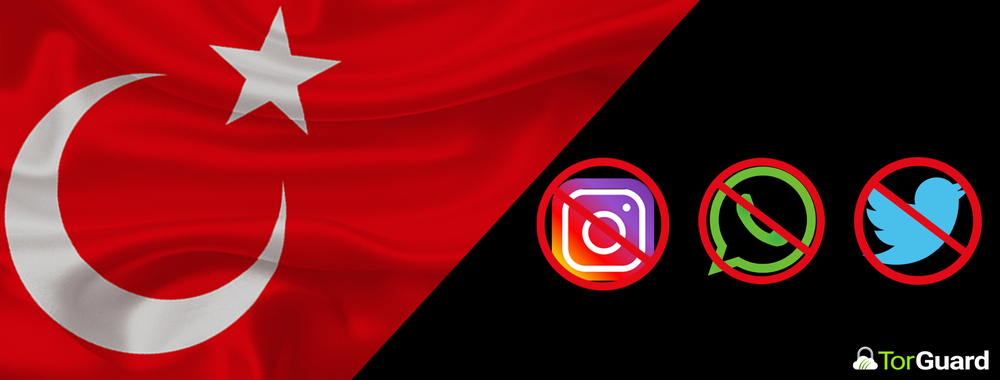
Twitter, Facebook (as well as its Messenger service), Instagram, and messaging app WhatsApp have been deliberately downed in parts of Southern Turkey. Youtube and Vimeo have also been intermittently impacted. The government claims that these restrictions are within its power, as Operation Peace Spring is a military effort and their use of the unchecked killswitch is within the realm of the law.
The Turkish government has not utilized the killswitch for social media since 2016, when a video depicting the immolation of Turkish soldiers was being widely circulated on popular platforms. This is Erdoğan’s first attempt at throttling social media since the aforementioned incident.
Accessing the Free and Open Internet in Turkey
If internet service were to become entirely suspended, there would be no way to access the open internet in Turkey. Restricted access with blocks that prevent social media use can be circumvented via a stealth VPN. Stealth VPNs like TorGuard don’t appear to be VPN use – they’re completely incognito, adding a new layer of privacy. Since VPNs can make traffic appear to come from anywhere in the world, regional blocks cannot prevent Turkish people from accessing internationally used social media networks or news outlets.