

If you feel like the ads you see are reading your mind, they are and they aren’t. You’ve actually given the internet all of the information it needs to target you with ads for things it believes you’ll be interested in buying. It knows exactly where you’ve been and has a good idea of where you’re about to go. It’s part Bladerunner, part Minority Report, and full creepy.
Those who are already well aware of what a terrifying place the internet can be have opted to use VPNs to prevent tracking and keep their data private. Advertisers don’t need to be making dossiers of you by logging browsing activity, and nobody needs to know what you buy or what you’re doing online. The desire for privacy is normal. You don’t have all of your conversations over a loudspeaker in a crowded public place, and without a secure VPN, everything you do online is a virtual equivalent of the same thing.
Some VPNs don’t offer the privacy and security that many users are led to believe they’re receiving, and many VPN companies have the audacity to charge their monthly users a fee for false promises. Does your VPN pass the blacklight test?
The Internet Itself is Stalking You
Almost every website you visit is tracking you in some way, even if you haven’t given them permission to do so. Nearly 90% of websites collect and store information about what you view and what you do while you’re there, and that information can follow you to other parts of the internet.
This information is often used to target you in advertising campaigns. In more nefarious scenarios, data about you is sold without your consent to larger marketing firms who will attempt to rope you into their widespread campaigns or use the data to profile their potential customers.
Most privacy based browsers or privacy enhancing browser extensions can throttle these sneaky stalking attempts, but none of them are completely effective. Companies that want your data are innovative in the ways they choose to obtain it, and nothing but a VPN is capable of fully preventing your data, personal information, habits, and history from getting into the wrong hands.
The only problem is that VPN websites cannot always be trusted. If you want true and full privacy, you need to use a VPN that passes the blacklight test.
What is a Blacklight Test?
Blacklight is a tool that checks sites for trackers and invasions of your privacy that you don’t see. Tracking cookies, Facebook data tools, Google data tools, keystroke capturers, and even session recording tools that create a video of everything you do on a website are often running in the background, unbeknownst to you.
Blacklight does a deep dive to discover what’s really going on. They check for ad trackers, third party cookies, trackers that evade privacy extensions or settings, keystroke capturing, session recording, Facebook pixels, Google analytics, and other tracking technology provided by third party companies or services.
The majority of websites use at least some of these features, with things like keystroke logging being among the most rare invasions of privacy.
Our Fact Finding Mission
It would be reasonable to assume that a VPN website would understand the importance of protecting visitor privacy, but many don’t. If the website selling you internet privacy is simultaneously invading your privacy by way of third party trackers, you’re getting off on the wrong foot. We used Blacklight to scan six popular VPN websites. Here’s the trouble we found.
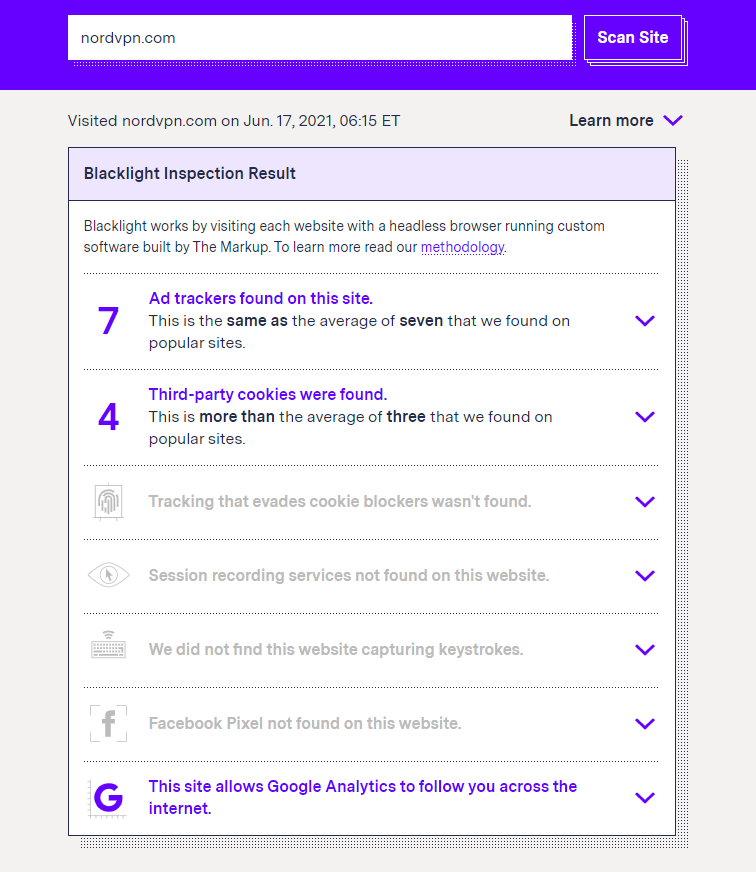
NordVPN
- 7 ad trackers
- 4 third party cookies
- Google analytics tracking
- Microsoft and Alphabet ad tech involvement
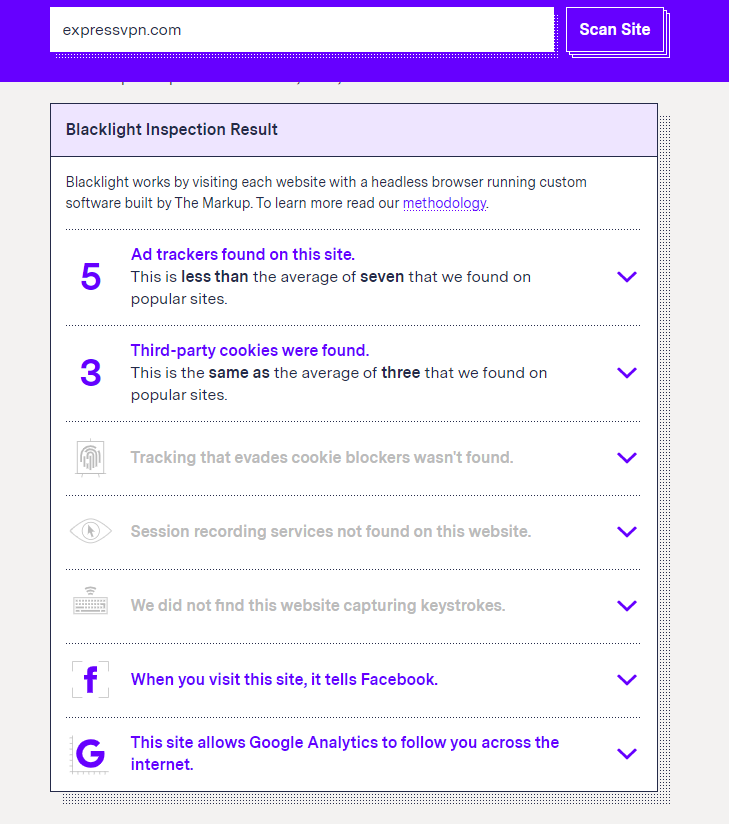
ExpressVPN
- 5 ad trackers
- 3 third party cookies
- Facebook tracking
- Google analytics tracking
- Microsoft and Alphabet ad tech involvement
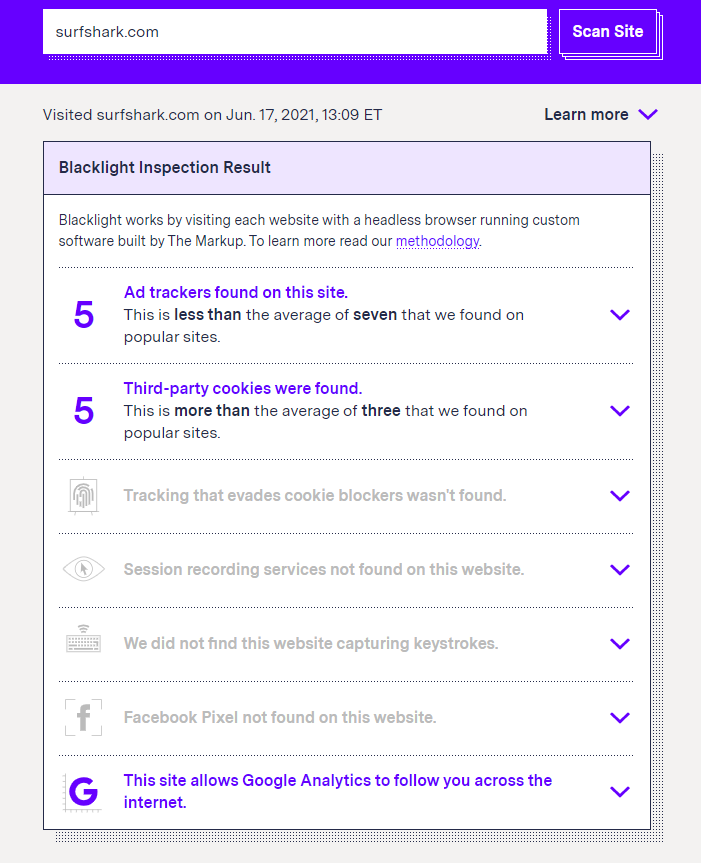
SurfShark
- 5 ad trackers
- 5 third party cookies
- Google analytics tracking
- Microsoft, Alphabet, and HotJar ad tech involvement
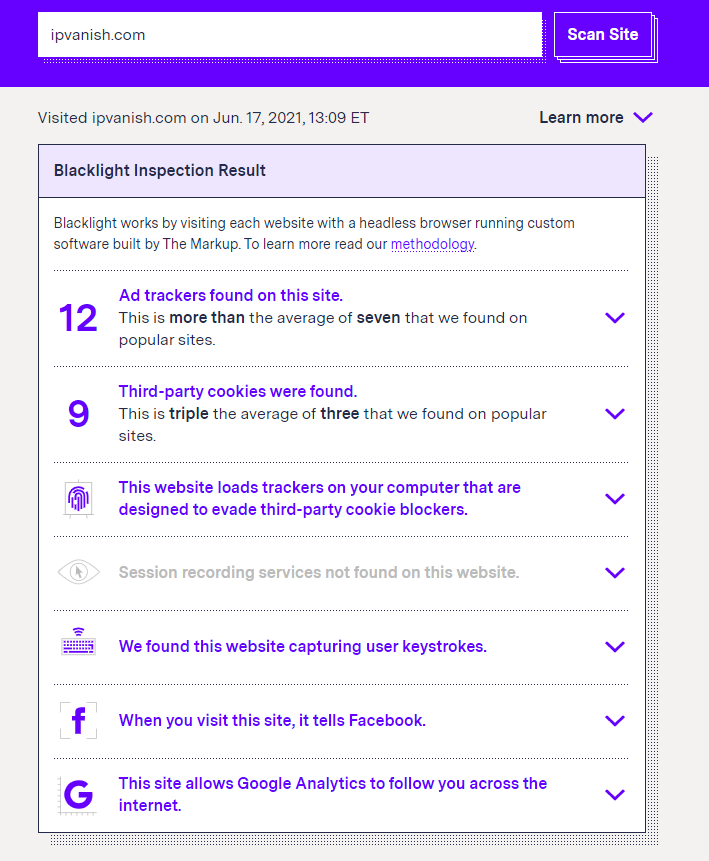
IPvanish
- 12 ad trackers
- 9 third party cookies
- Evasive trackers and cookies
- Keystroke and click monitoring
- Google analytics tracking
- Facebook pixel
- Microsoft, Alphabet, ad tech involvement
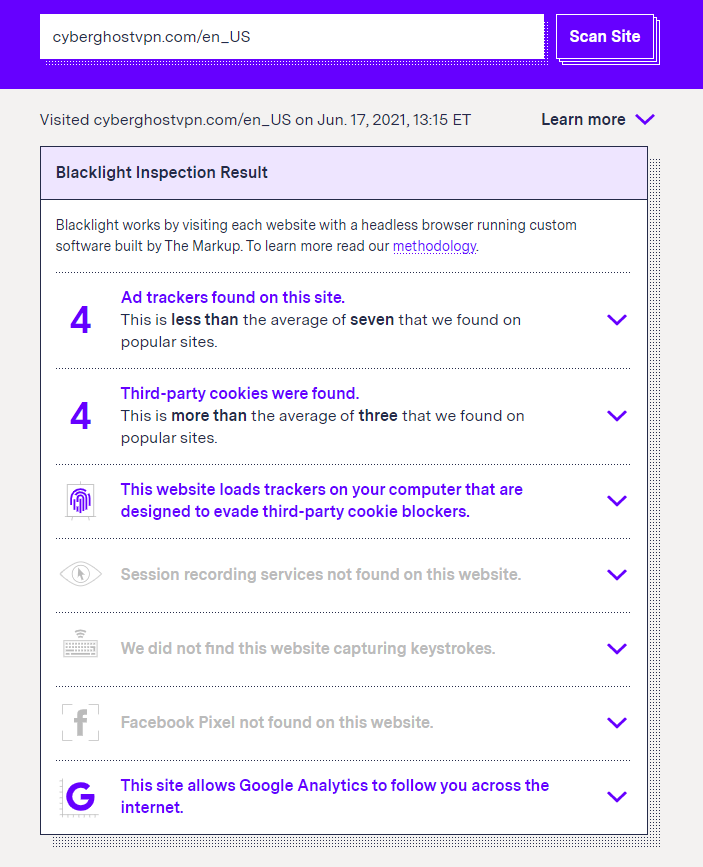
CyberghostVPN
- 4 ad trackers
- 4 third party cookies
- Evasive trackers and cookies
- Google analytics tracking
- Microsoft, Alphabet, and HotJar ad tech involvement
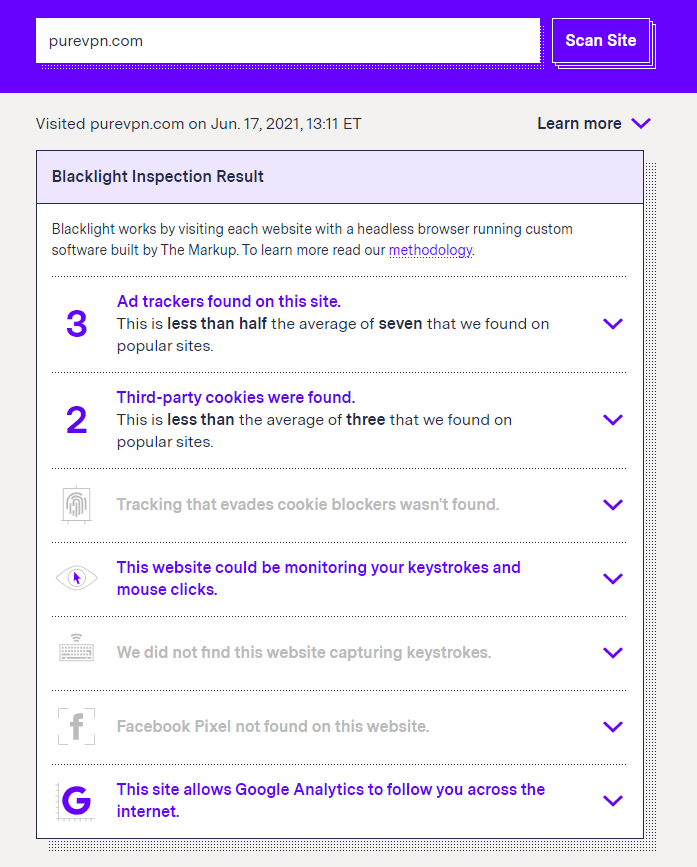
PureVPN
- 3 ad trackers
- 2 third party cookies
- Keystroke and click monitoring
- Google analytics tracking
- Microsoft, Alphabet, and HotJar ad tech involvement
These three VPNs are consistently rated as some of the best VPNs, yet they cannot practice what they preach on their own websites. This is troubling. You’re counting on these VPN companies to keep you away from the very things they’re using to monitor your activity when you visit. How much can you trust a privacy company that doesn’t take your personal privacy seriously?
TorGuard Passes the Blacklight Test
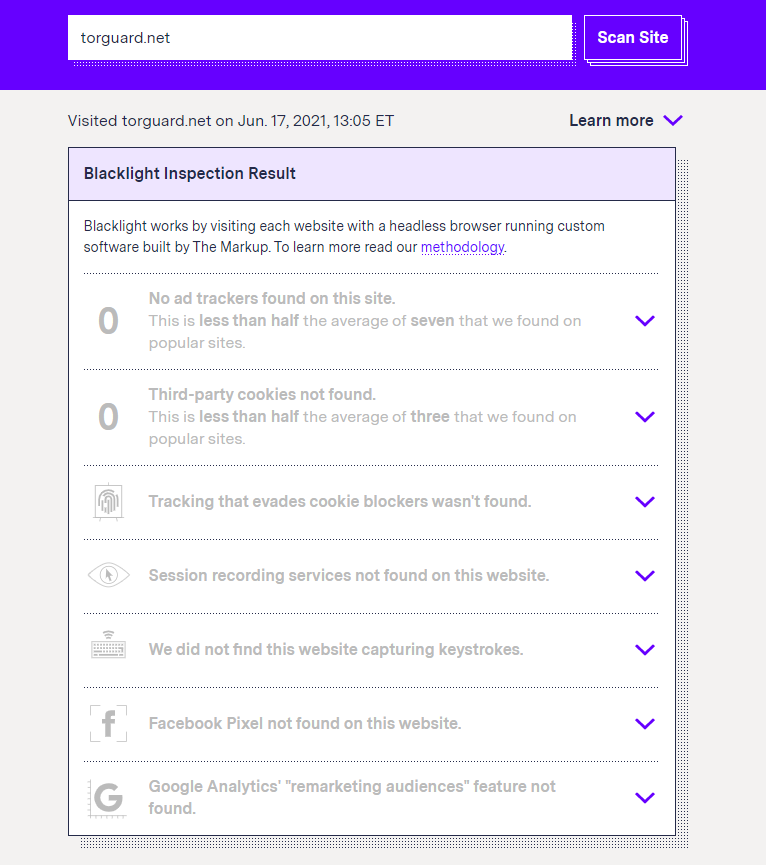
TorGuard is determined to do things the right way. We pass the Blacklight test for everything. Our message is consistent with what we provide. We don’t want anyone to monitor you online, ever. It’s never acceptable. We don’t use ad trackers, third party cookies, Google analytics, or any other kind of monitoring on our website that could log activity, invoice ID’s or usernames and potentially de-anonymize a user. We’re not interested in doing anything that’s contrary to our purpose.
In addition to these blatant violations of your web browsing privacy, some VPN companies will forward you to a website to login and connect to your VPN, which introduces a whole new level of privacy vulnerabilities. Depending on the type of trackers embedded on the login page it’s possible that user information like invoice ID’s or user ID’s are being syphoned up and stored by a third party.
We’re not interested in projecting an image. We’re interested in doing what we set out to do and making privacy the foundation of our entire company. We’re proud that you can trust us more than you can trust any major VPN. We wouldn’t have it any other way, even if it means losing analytics and marketing data. At the end of the day, your privacy is more important than our marketing. And it always will be.